
 EN
 ES
 PT
 RU
 AR
 KO
 MY
 FIL
 BE

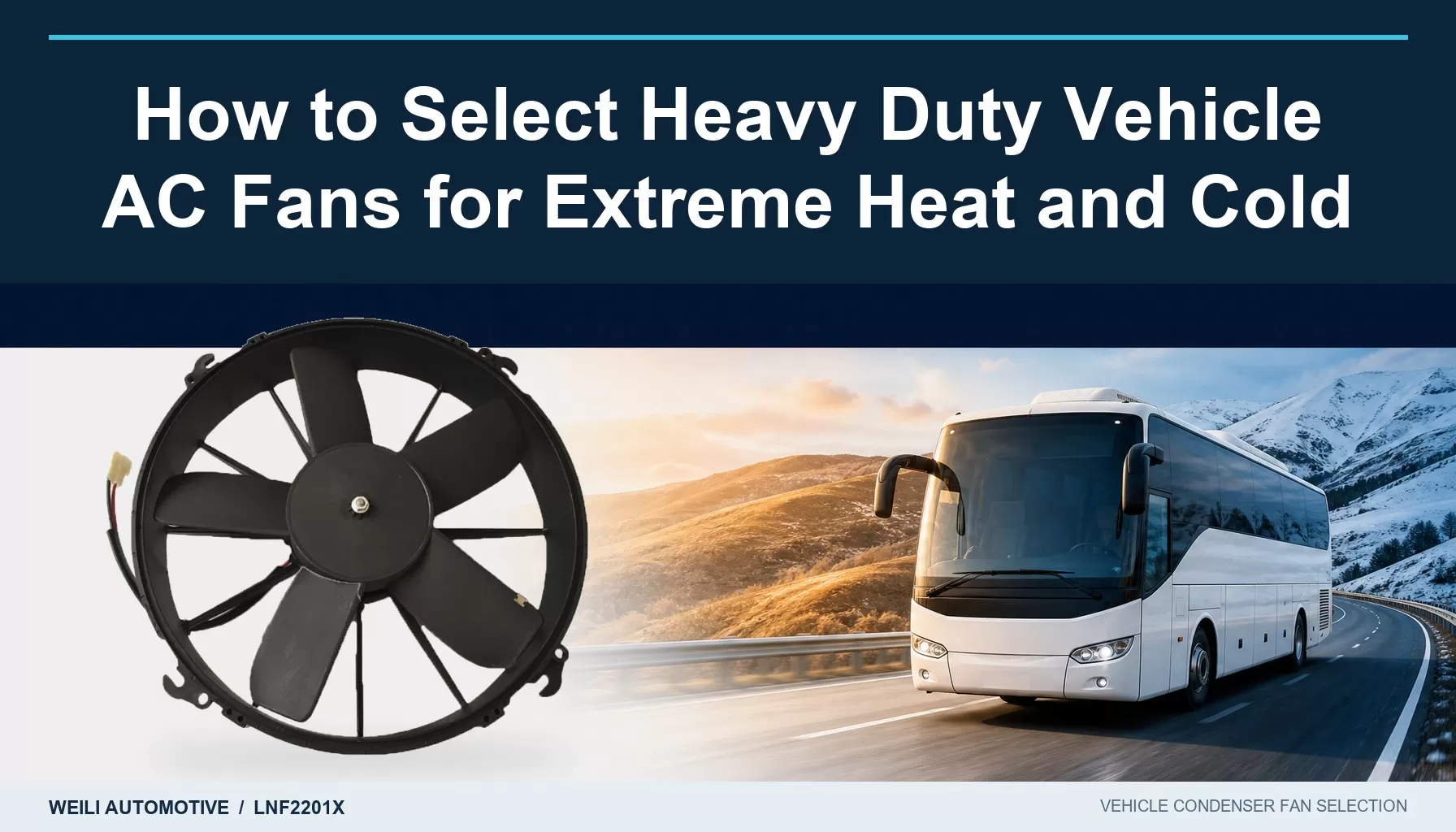
A heavy duty condenser fan should be selected against two separate demands: sustained airflow at the hottest installed operating condition, and reliable starting after the coldest expected soak. Check the exact version, connector voltage, operating limits and any speed reduction at high temperature. For our LNF2201W and LNF2201X commercial vehicle condenser fans, published reference figures are a starting point; selection for extreme heat and cold requires evidence covering the intended duty.
Define the temperature duty at the installed fan
Regional weather data is only the starting point. Record the air temperature where the fan actually operates, its proximity to hot components, and whether the vehicle is moving or stationary. Keep parked heat soak separate from powered operation. For cold conditions, define how long the assembly remains unpowered before its first start.
Include exposure to road spray and condensation where relevant. The scope of ISO 16750-4 relates climatic loads for vehicle electrical and electronic equipment to mounting location. Use that framework to define the evidence needed for your Weili part inquiry. Neither of the two model pages discussed here establishes a climatic qualification against that standard, so do not turn a general standard reference into a product compliance claim.
| Exposure | Conditions to define | Evidence to request |
|---|---|---|
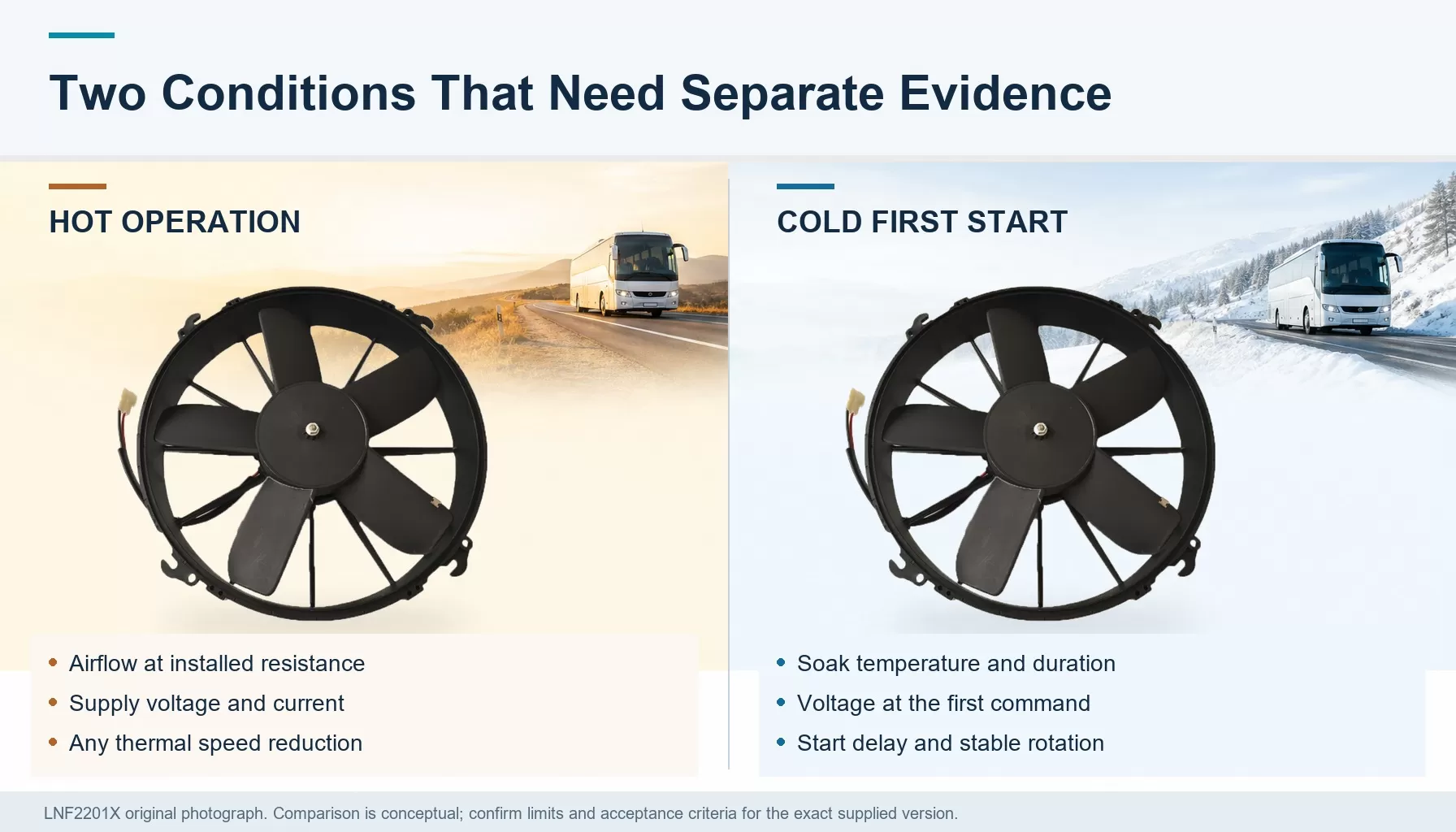
| Hot operation | Local air temperature, duration, supply voltage, command and airflow resistance. | Airflow or speed, current and protection behavior throughout the agreed hot duty. |
| Cold first start | Unpowered soak temperature and duration, connector voltage and first command. | Start delay, current, rotation and attainment of the agreed operating condition. |
| Temperature changes | Transition profile, moisture exposure and installed orientation. | Applicable cycling or condensation results, functional recovery and inspection findings. |
| Storage | Unpowered temperature limits and duration. | Storage qualification and a separate statement of powered operating limits. |
Agree these conditions before comparing quotations. Otherwise, one supplier may be quoting a storage limit while another is discussing continuous operation, leaving apparently similar products qualified for different duties.
Check hot airflow and any speed reduction
At the hot operating point, ask whether the fan maintains the airflow required through the installed condenser. Confirm the pressure condition as well as airflow: an unrestricted airflow figure is not interchangeable with performance against condenser and installation resistance. Where available, use the fan curve and the system resistance to assess the working point.
Our LNF2201W brushless condenser fan provides a concrete reference for a model inquiry. Its published data include a 26 V test voltage, current of no more than 13.5 A, static pressure of 100 Pa and air volume of at least 2,500 m³/h. Those figures help define a candidate; they do not establish its airflow at your hottest operating temperature. Request the conditions behind the data and the relevant hot-running evidence for the proposed version.
Ask specifically about thermal protection and derating, meaning any reduction in output as temperature rises. SPAL’s brushless fan technical tables, for example, distinguish operating temperature, storage temperature and a speed-derating threshold. That distinction is useful when reading specifications; the limits of another manufacturer’s fan cannot be transferred to a Weili model.
For an LNF2201W assessment, agree the minimum hot-duty airflow and ask whether any protection response changes it. A fan that continues rotating may still deliver too little air after reducing speed. If the proposed version supports speed control, evaluate the actual command strategy: a reduced command must still meet the cooling requirement, while a higher command must remain within the approved electrical conditions. Do not extend the published 26 V current reference to other supply or temperature conditions without supporting data.
Verify the first start after a cold soak
Cold storage survival and powered starting answer different questions. A useful cold-start assessment keeps the complete assembly at the agreed soak condition, then records its response to the first command before it warms appreciably. Ask for connector voltage, starting current, start delay and rotation or speed. Define when the fan must reach the required operating condition.
Test the intended fan and electrical configuration. Our 12-inch LNF2201X suction axial fan listing includes paired test-voltage entries of 27 V and 13.5 V. These entries should not be treated as proof that one supplied unit accepts both nominal vehicle voltages. Confirm the ordered voltage version, connector, permissible supply conditions and control interface before planning the cold-start check.
If a candidate starts slowly or needs a second command, record the behavior against the agreed criteria and investigate the supply and fan together. Do not accept a warm restart as evidence of a successful cold first start. Equally, a test with an unsuitable supply configuration does not isolate the fan as the cause.
Treat moisture and temperature changes separately
When reviewing either Weili model, request the scope behind any proposed water or dust protection claim; the product pages cited here do not establish an enclosure protection rating. Ask whether the evidence covers the motor, controller, connector and supplied harness. Even a documented enclosure rating would not establish hot-duty airflow or starting performance after a cold soak.
Consider the transitions the installed assembly will encounter, rather than requesting every available environmental test. A fan exposed to road spray after heating may need a different verification plan from one sheltered within a dry compartment. Intertek’s climatic testing overview separates temperature exposure and cycling from humidity, condensation and cold-water shock. Use those categories to identify relevant questions, then agree the applicable method and severity with the supplier.
Keep the same assembly boundary used in your LNF2201W or LNF2201X inquiry when reviewing the results. A motor-only report leaves questions about the finished fan and its connections. Check function after the agreed exposure, inspect for damage or moisture-related issues, and match the tested sample’s configuration to the proposed purchase item.
Agree the release criteria before ordering
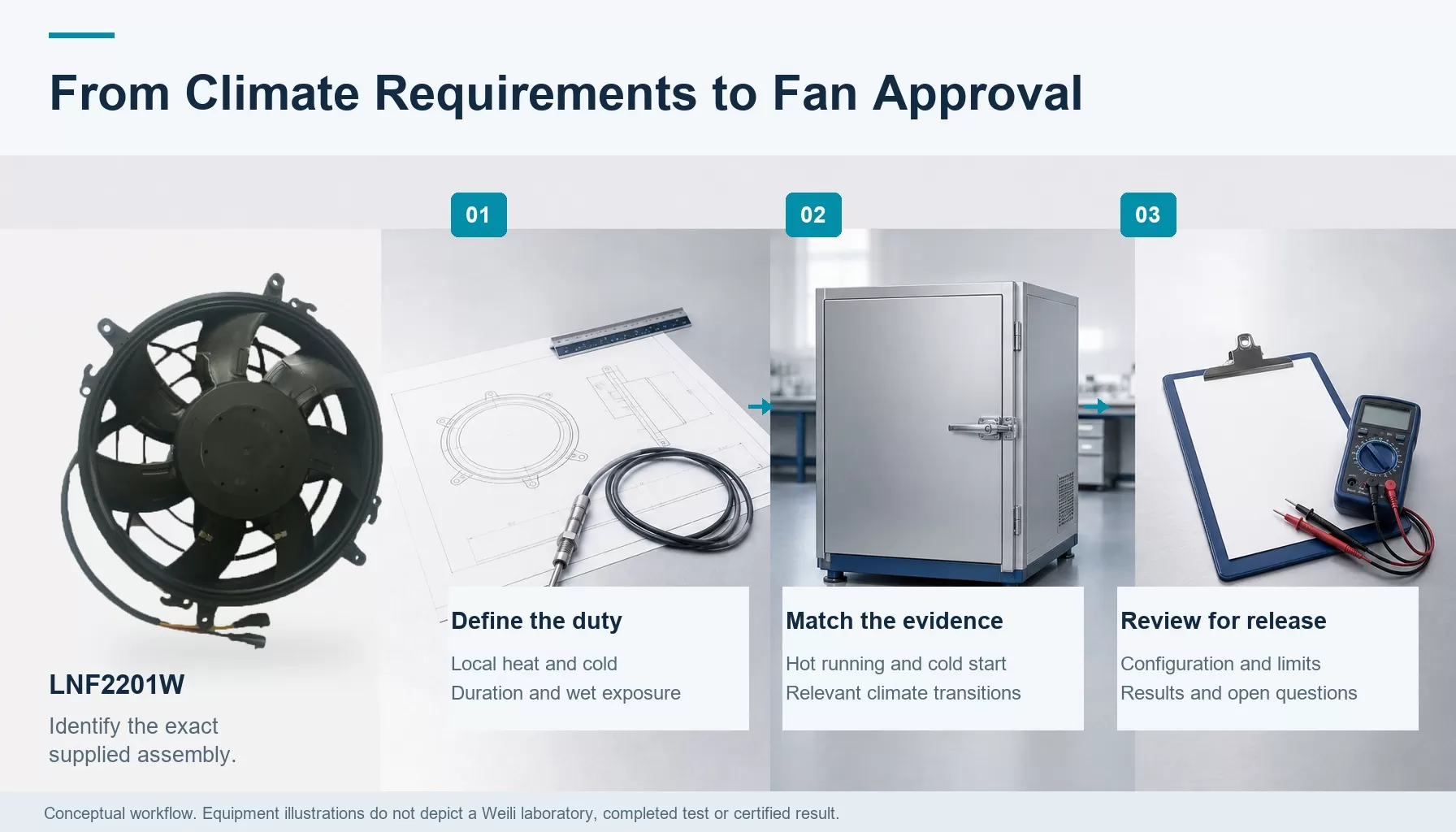
Turn “suitable for extreme weather” into a short acceptance record that engineering, purchasing and the supplier can use together:
- Identify the supplied assembly. Record the model, voltage version, revision, connector, control interface and mounting arrangement. For LNF2201X, resolve the supplied voltage version before accepting a report against the paired catalogue entries.
- Define the duty and pass conditions. Separate storage, hot running, cold first start and relevant temperature transitions. State durations, supply conditions, airflow resistance and required functional behavior before testing.
- Review the results and open items. Compare performance before, during and after exposure where appropriate. Keep the LNF2201W catalogue reference separate from temperature-specific results. Resolve unexplained cutouts, delayed starts or reports covering a different configuration before release.
For a Weili model inquiry, send us the installation drawing or photos, temperature duty, electrical requirements and required airflow at pressure. Ask which available product data and test evidence cover that duty, and which points still need confirmation. This gives the discussion a defined engineering target instead of relying on an “all-weather” description.
FAQ
What temperature range should I specify for a Weili condenser fan
Specify the required powered operating range and the separate unpowered storage conditions, including exposure durations. For the LNF2201W and LNF2201X pages reviewed here, a qualified ambient operating range is not stated. Request model-specific confirmation before assigning either fan to your fleet’s temperature duty.
Does the LNF2201W brushless motor establish all weather suitability
No. The brushless designation identifies the motor type. Suitability still depends on the exact assembly’s operating limits, hot-duty output, cold-start behavior and relevant environmental evidence. The published electrical and airflow figures are useful reference data, but do not replace those checks.
Can I order one LNF2201X for both 12 V and 24 V vehicles
Do not infer that from the paired voltage entries in the product listing. Ask us to confirm the correct supplied version for each vehicle system, including its connector and electrical requirements. Keep the confirmed part identification in the purchasing record so the voltage choice remains clear on repeat orders.
What information helps Weili assess an extreme temperature inquiry
Provide the candidate model or existing part identification, mounting location, local temperature conditions, soak duration, connector supply voltage, control requirements and airflow target at pressure. Add any spray or condensation exposure. These details establish which product information is relevant and what evidence must be confirmed before selection.