
 EN
 ES
 PT
 RU
 AR
 KO
 MY
 FIL
 BE

Specify a fleet HVAC motor by its replacement scope, exact electrical version and installed interfaces, then approve that configuration before committing to repeat orders. A voltage label or a broad vehicle description is only a starting point. For purchasing, turn "premium quality" into written acceptance requirements: what must fit, what must function under the agreed conditions, and what must remain unchanged in later deliveries.
Weili's commercial vehicle HVAC motor range includes separate evaporator blower and condenser motor references. This guide concerns those auxiliary HVAC components, not traction or starter motors. The procurement task is to select the right motor configuration for a particular air-conditioning unit and preserve that approval through subsequent purchases.

Define whether the order covers a motor or an assembly
Start with the existing HVAC unit, its part reference and the proposed repair boundary. A motor-only purchase leaves questions about the retained wheel, hub, housing and mounting hardware. Record which components will be reused, who will assemble them and who will verify the finished installation. A supplier quote should describe that same scope.
Motor-only supply can make sense when the retained parts are suitable and the repair process is controlled. The trade-off is the work needed to establish that the replacement motor and reused parts form an acceptable assembly. If those parts cannot be approved for reuse, compare a complete blower or fan assembly instead. Compare the cost of an approved installed repair, rather than a bare motor price against an assembly price.
Resolve catalog differences before comparing quotations
The ZD292L-W evaporator blower motor reference gives test voltages of 27V/13.5V and a speed of 3900 plus or minus 200 rpm. The LD2201 brushed condenser motor reference also gives 27V/13.5V, but a speed of 3500 plus or minus 200 rpm. Their different HVAC functions and reference speeds are reasons to keep separate specifications. The shared voltage notation does not establish interchangeability.
Ask Weili to identify the exact nominal voltage version and match each test voltage to its corresponding current, speed and load conditions. Do not interpret the slash-separated figures as proof that one supplied motor can operate across both nominal systems. Put the confirmed version on the quotation, sample label and purchase order.
The ZD292L-W reference also includes an airflow point at 100 Pa. For a motor-only order, request the wheel, housing and test arrangement behind that point. Use the resulting assembly description when comparing data; do not treat an airflow figure as a promise for an unidentified retained wheel or a different HVAC installation.
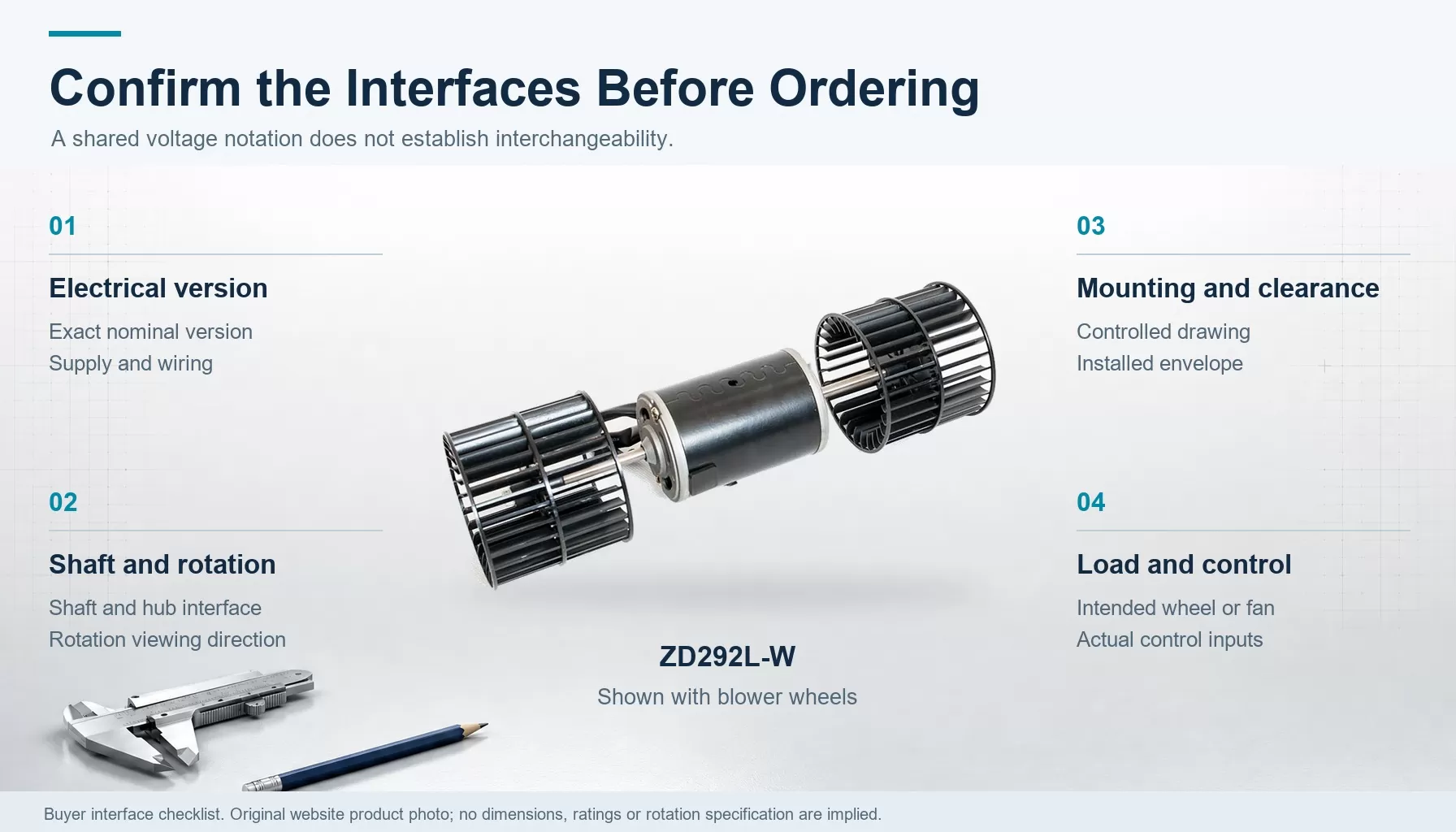
| Interface | Evidence to agree | Reason to hold approval |
|---|---|---|
| Electrical version | Exact nominal version, test supply, current conditions and wiring | Unresolved voltage mapping or a connector that requires an unapproved change |
| Shaft and rotation | Shaft dimensions, hub engagement, retention and rotation with viewing direction | The wheel cannot be retained as intended, or rotation is ambiguous |
| Mounting and clearance | Controlled drawing, mounting pattern, installed envelope and lead routing | Fit depends on modifying the approved mounting or housing |
| Load and control | Intended wheel or fan load, speed settings and actual control interface | Operation is demonstrated only without the intended load or control |
Both motor references include drawing images. Request the current controlled drawing with tolerances for the quoted variant before approving fit. If the candidate uses electronic speed control, also request its actual command and wiring requirements; do not assume compatibility with the vehicle's existing control from a motor technology label.
Approve a defined installation rather than a catalog family
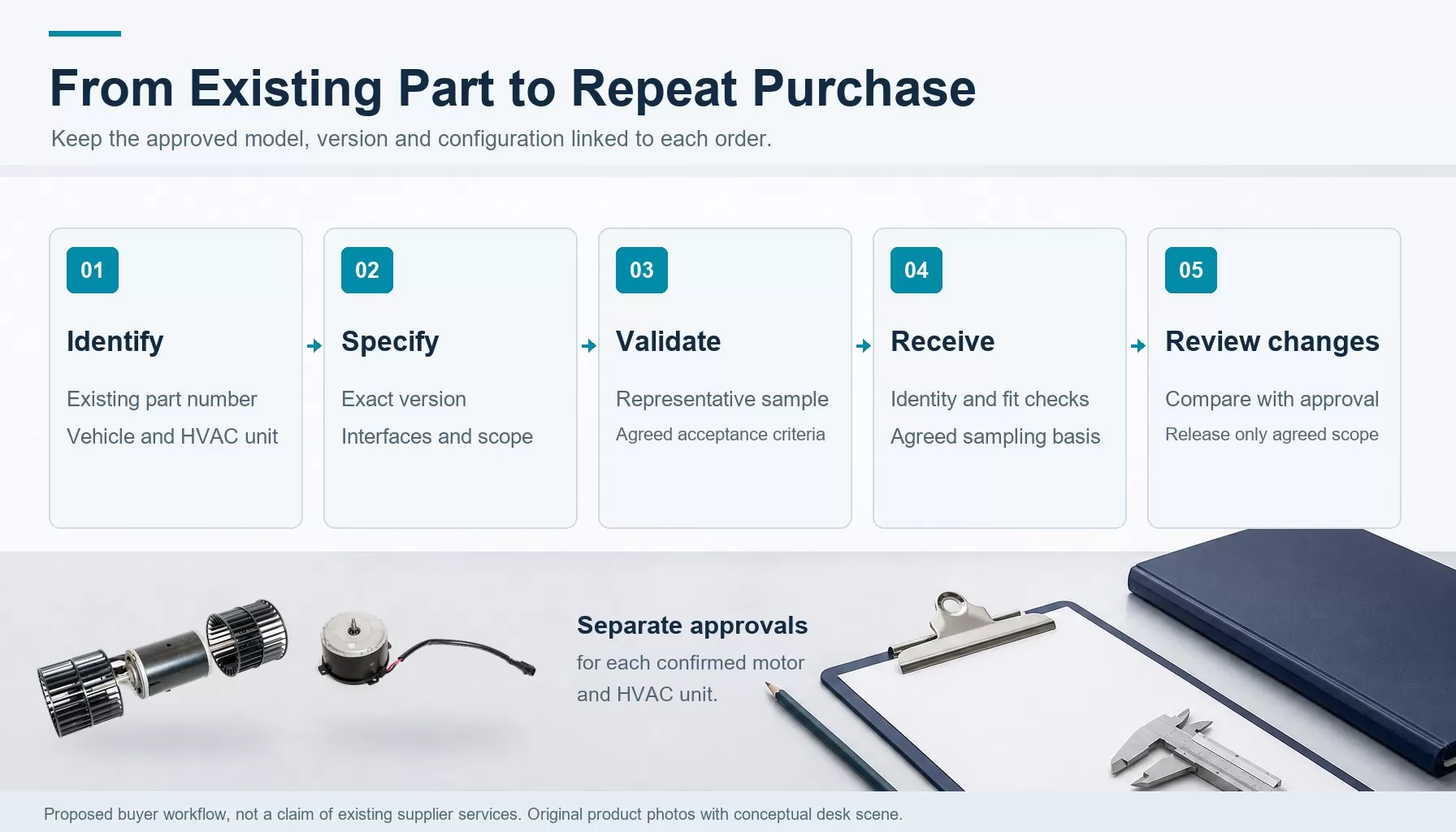
For a ZD292L-W candidate, identify the retained blower components in the sample record. For an LD2201 candidate, identify the intended condenser fan and mounting. Agree on acceptance criteria before evaluating the sample, and retain the exact part number, electrical version and drawing revision with the results.
Ask the responsible technician or test provider to assess operation with the intended load, supply and control settings. Define what will be checked, such as starting, speed response, current, clearance and the assembly's required airflow or noise criteria. Record any installation change. A sample that works only after an unapproved alteration is not evidence for the original replacement specification.
Durability approval needs a separate statement of operating conditions. Provide the duty pattern, mounting location and relevant heat, moisture or vibration exposure; request model-specific limits and evidence applicable to that configuration. Do not turn a successful fit check or a catalog speed into an hours-of-service promise. Until evidence is agreed, keep approval limited to what was actually evaluated.
Carry the approved configuration into repeat purchases
Use the sample approval record as a purchasing reference, not just a workshop note. Agree with the supplier how each delivery will identify the approved model, version and revision, and how a lot can be associated with the order. Request a change-notification arrangement for features that matter to your approval, such as the shaft, winding, bearings, connector or control electronics. These are requirements to negotiate, not services to assume.
For receiving inspection, agree which identity, dimensional and functional checks are practical for the order, who performs them and how discrepancies are handled. Establish the sampling basis with the supplier rather than inventing a universal inspection quantity. If a proposed substitute differs from the approved ZD292L-W or LD2201 configuration, review the affected interfaces and acceptance criteria before releasing it to fleet use.
Keep platform approvals separate until equivalence has been established. A common motor reference across two HVAC installations is a reason to compare their requirements, not permission to pool stock automatically. Record which vehicle and HVAC-unit combinations each approval covers, so a warehouse substitution does not silently expand its scope.
Prepare a specification review before requesting volume pricing
For a Weili motor specification inquiry, send the existing part number, label and installation photos, the HVAC-unit reference, the required voltage version and the motor-only or assembly scope. Include the relevant drawing, retained wheel or fan details and operating conditions. Ask for a written proposed configuration and a list of unresolved requirements before comparing volume quotations.
FAQ
Can the evaporator motor be ordered for an existing blower wheel
Use the ZD292L-W evaporator motor reference as the starting point for a fit review, not confirmation of an existing wheel's compatibility. Supply the wheel and hub details, shaft interface, retention method and required rotation. Ask which dimensions and assembly checks must be resolved before a motor-only sample order.
How should separate voltage versions be quoted
Request a separate order line for each confirmed motor version, with its quantity and approved reference. Use Weili's contact destination to confirm minimum order quantity, sample availability and production lead time for those specific lines. Ask when the lead-time commitment begins and whether sample approval is a condition; do not assume that terms for one version cover another.
What durability and warranty documents should accompany the decision
For the selected model in Weili's HVAC motor catalog, request the applicable operating limits, qualification evidence and written warranty terms. Check the covered configuration, test conditions, exclusions and information needed for a return or claim. Neither a product-category label nor a reference speed establishes a service-life guarantee or the warranty for your order.