
 EN
 ES
 PT
 RU
 AR
 KO
 MY
 FIL
 BE

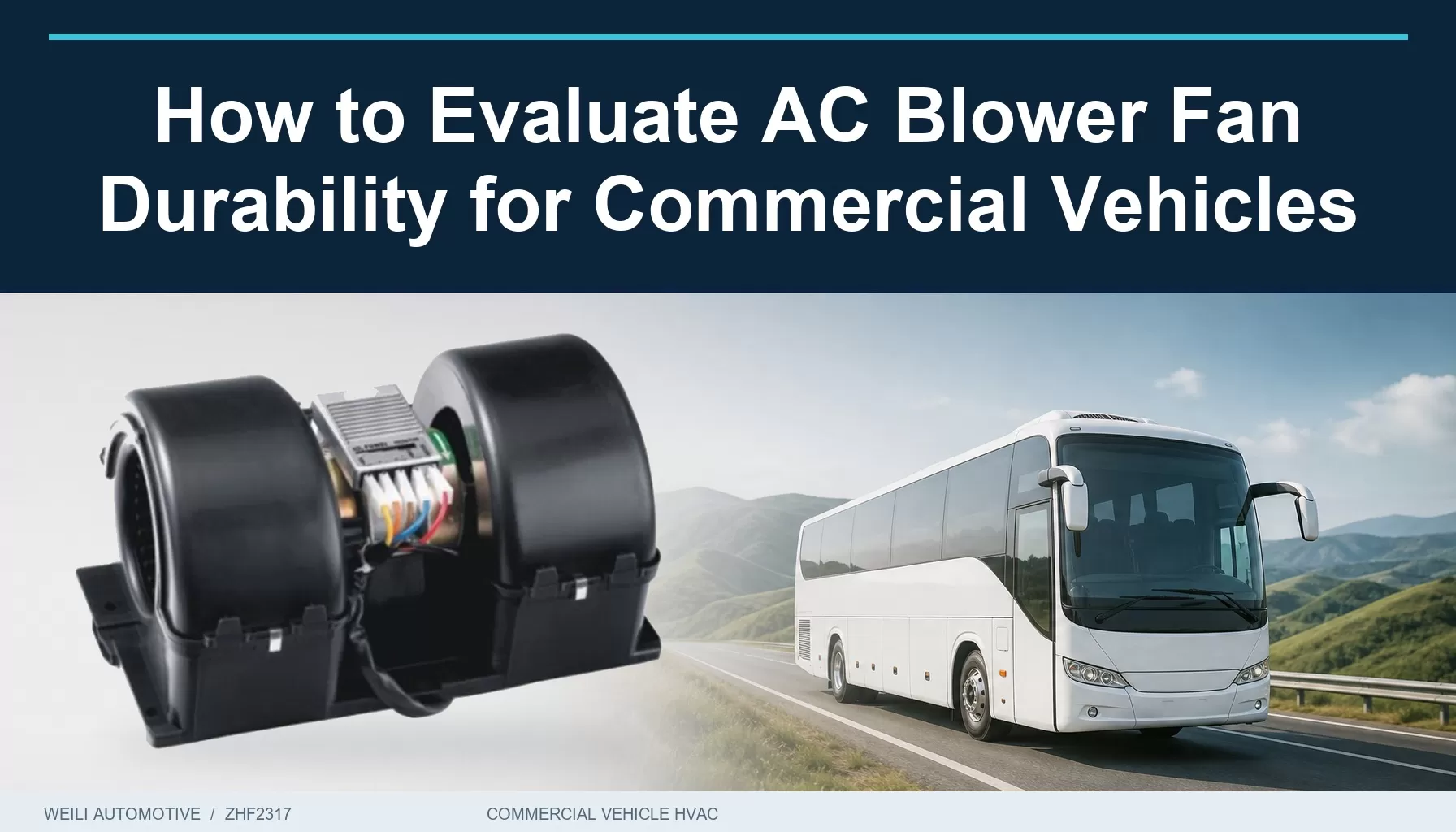
A durable commercial vehicle AC blower needs to retain the required airflow through a defined service profile. Before approving a long-life claim, establish which assembly was tested, how it operated and what counted as failure. For Weili blower selection, use the published electrical and airflow data to identify a candidate, then request endurance evidence applicable to that configuration. An advertised hour count alone cannot establish how long the blower will serve in your vehicle.
Define the service requirement before comparing lifetime claims
Write the requirement around blower operation. Record expected blower-on hours, time at each speed and the frequency of starts. Include the intended supply range, installation environment and working airflow resistance. A vehicle that spends much of its shift parked may still run its HVAC system; route mileage alone leaves that operating time undefined.
For a candidate such as the Weili ZHF2317 evaporator blower, distinguish the published reference point from your service requirement. Its specification gives at least 800 m³/h at 100 Pa and test voltages of 27 V / 13.5 V. Confirm the applicable voltage version and assembly before using those values in an approval document. The paired voltages do not establish that one unit operates on both supplies.
Define useful service as well as running time. Agree how airflow at a stated pressure will be checked after endurance testing, together with applicable current, noise and restart acceptance criteria. Set those limits from the vehicle requirement. A motor that still turns has not necessarily demonstrated that the blower still meets the required cabin airflow.
Read a test duration together with its conditions
The ZHF2317 product heading includes "6000hours." Before adopting that figure in a fleet specification, request its test basis: voltage version, tested assembly, load profile and acceptance criteria. Until that basis is established, keep the figure out of a guaranteed vehicle service-life requirement.
Different operating profiles answer different durability questions. For example, SMP Engineered Solutions identifies separate endurance test profiles, including high-speed, programmed-load, accelerated and low-speed tests. That distinction is useful when reviewing a report: ask which profile represents your intended operation. Those published capabilities belong to SMP and do not establish testing performed on a Weili model.
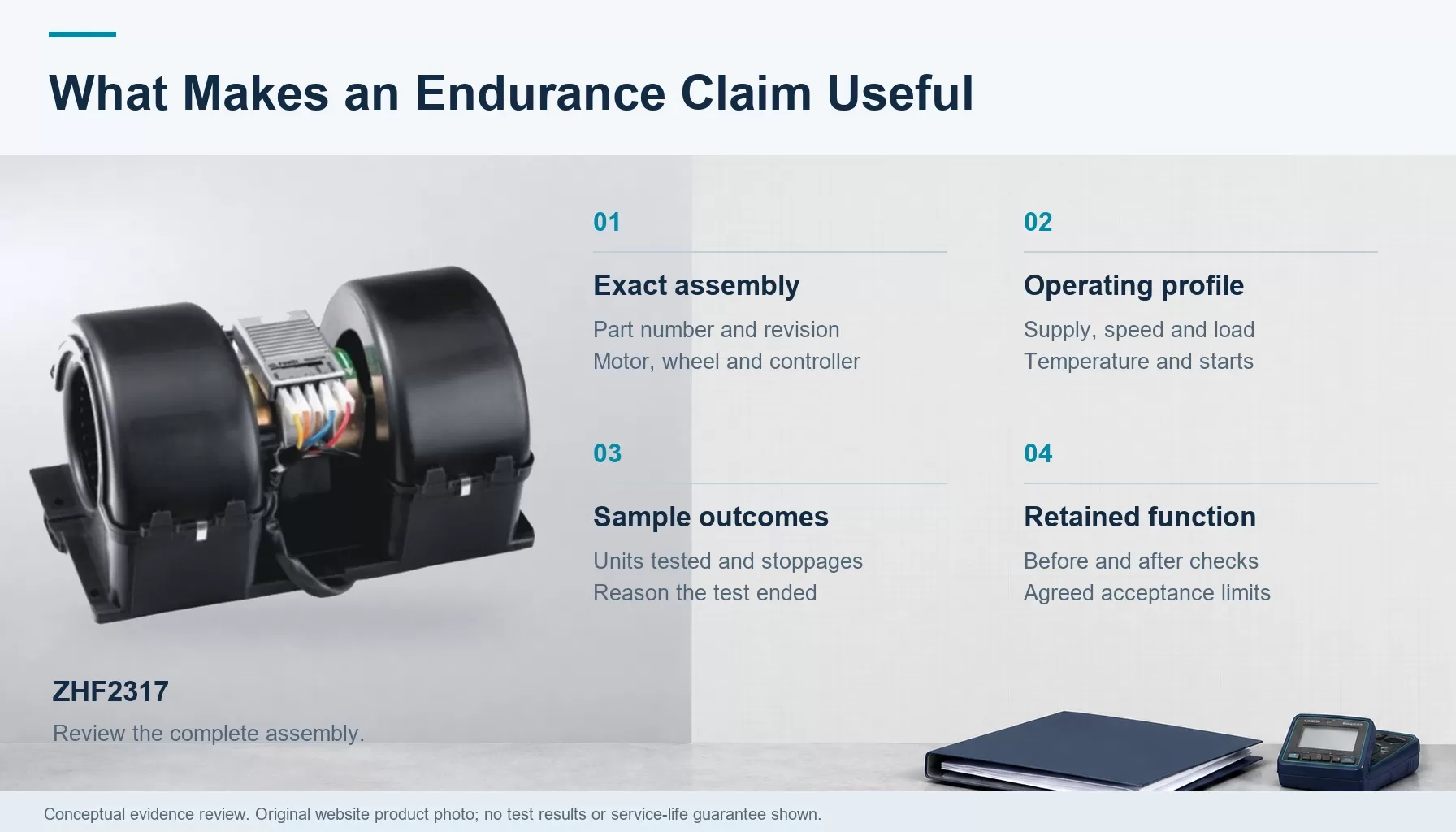
| Evidence item | What to establish | Approval consequence |
|---|---|---|
| Tested assembly | Part number, revision, motor, wheel and any included controller | Motor-only evidence leaves the complete blower assembly unverified. |
| Operating profile | Supply, speed or command cycle, load and temperature | An hour count is relevant only within its documented conditions. |
| Sample outcomes | Units tested, failures, stoppages and reason the test ended | Completed test hours alone do not describe fleet reliability. |
| Retained function | Before-and-after results using an agreed measurement method | Approval should cover useful output as well as continued rotation. |
| Supply applicability | Relationship between the tested revision and the offered assembly | Resolve configuration changes before applying an earlier result. |
Keep the endurance report and warranty terms separate in the purchase review. Ask for the written coverage, exclusions and claim process for the exact offered product. Neither "6000hours" in a heading nor a completed laboratory run, by itself, establishes a replacement commitment.
Judge a brushless candidate as a complete assembly
Brushless architecture removes brushes from the motor design, as described in SMP's technical reference. That makes it worth evaluating when brush wear is the concern, but it does not supply a lifetime figure for an individual blower. The selection trade-off includes confirming the electrical and control interface and obtaining evidence for the complete offered assembly before replacing an existing configuration.
Weili's brushless centrifugal blower candidate provides a concrete starting point: the model field is ZHF2101W, with a 26 V test voltage and at least 1,000 m³/h at 100 Pa. Its heading uses ZHF2101ZW. Ask Weili to confirm the exact designation and drawing revision before requesting a sample or linking a test report to an order.
The two published airflow points help describe candidates; they do not rank their endurance. ZHF2317 and the brushless candidate have different stated test voltages, and their catalog points do not establish performance in your HVAC housing. Obtain the applicable curves and endurance documentation, then compare each candidate against the same vehicle requirement.
Approve retained performance in a representative installation
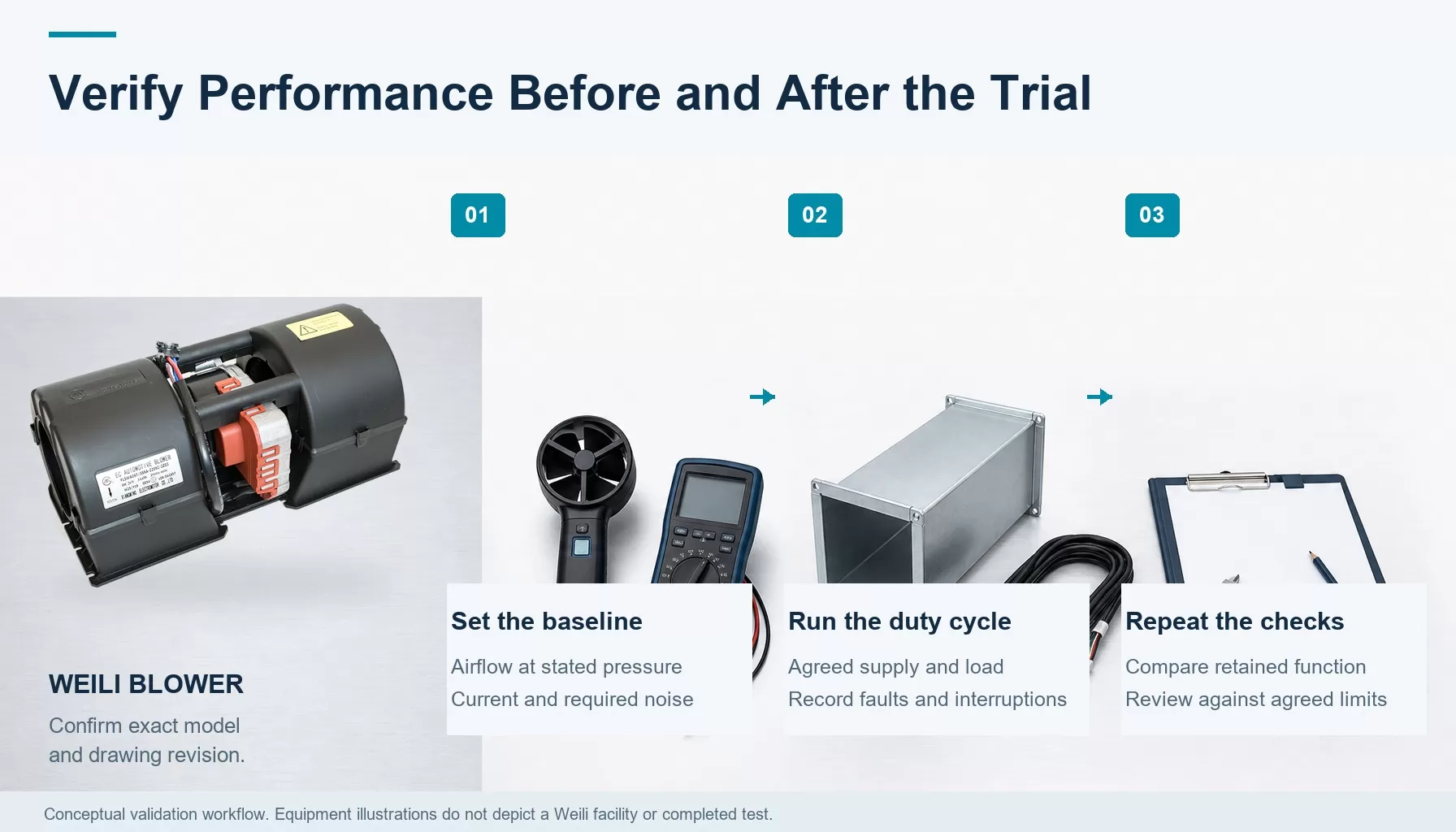
Once the exact Weili configuration is identified, use a trial that reproduces the relevant operating profile. Agree the procedure before the trial starts so a sample cannot pass simply because its motor remains operational. Keep the initial and final measurement conditions consistent enough to judge any change against the agreed limits.
- Record the sample part number and revision, then establish baseline airflow at the agreed pressure, current and any required acoustic measurements.
- Run the agreed operating cycle and record interruptions, faults and deviations. Ask how the cycle represents the intended blower use.
- Repeat the functional checks and inspect the assembly against the agreed acceptance criteria. Record the outcome and the configuration it covers.
For a ZHF2317 inquiry, identify the voltage version alongside the model. For the brushless candidate, resolve the ZHF2101W / ZHF2101ZW designation and control requirements. This gives the supplier a defined assembly to review and prevents a general product description from becoming the approval basis.
Send Weili your blower durability requirements with the vehicle or HVAC assembly reference, existing blower identification, operating profile and acceptance criteria. Request the applicable specification, available endurance documentation and written warranty terms before deciding whether to proceed with a trial.
FAQ
Does the ZHF2317 hour claim guarantee a service interval
The "6000hours" wording in the ZHF2317 product heading does not provide the test conditions needed to establish a fleet replacement interval. Request the supporting method and results for the exact version, then assess their relevance to your operating profile. Confirm any contractual coverage separately.
Can the Weili brushless blower replace an existing brushed unit
The public description establishes a brushless candidate, but does not establish a direct replacement for your existing assembly. Provide the current part number, mounting drawing, supply range and control interface. Confirm the exact offered designation and compatibility before ordering a trial unit.
Should buyers choose the model with the higher published airflow
Choose against the required operating point and durability evidence. The 800 m³/h and 1,000 m³/h minimum reference values at 100 Pa do not prove which model will last longer or deliver the required airflow in your installation. Request the applicable performance data for each voltage version and check the selected assembly in the intended housing.
What should an endurance documentation request include
Use the Weili contact page to send the exact candidate, drawing revision, supply conditions and expected blower duty profile. Specify the required retained airflow and other acceptance limits, and ask which available reports apply. If the evidence does not cover the proposed use, define what further validation is needed before approval.