
 EN
 ES
 PT
 RU
 AR
 KO
 MY
 FIL
 BE

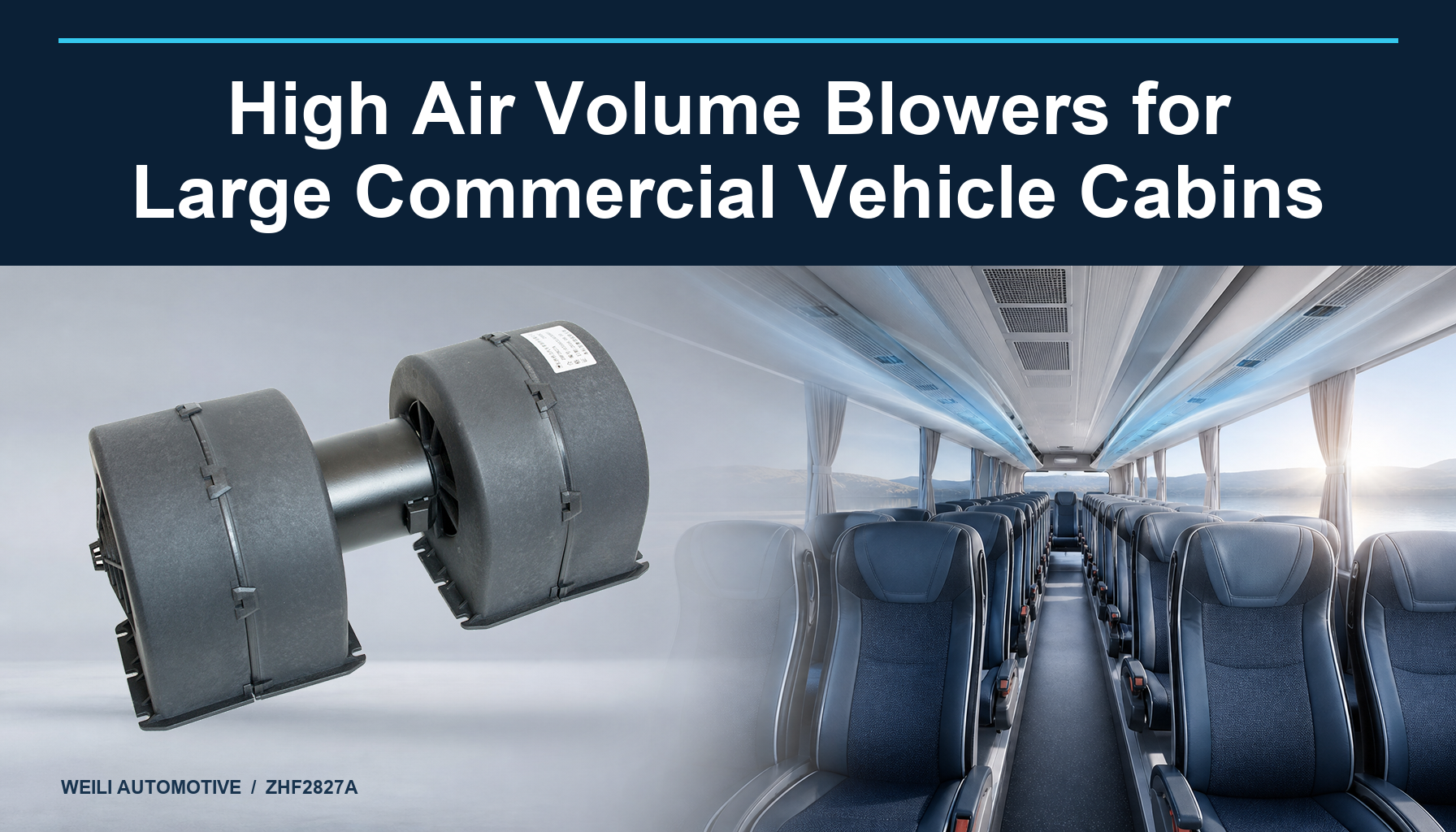
High Air Volume Blowers for Large Commercial Vehicle Cabins
For a large commercial vehicle cabin, select an evaporator blower by the airflow it can deliver against the installed system's resistance, then verify that air reaches the occupied areas. A high free-air rating alone cannot establish cabin suitability. At Weili, our vehicle evaporator blower range includes models with published airflow at 100 Pa, giving buyers a useful starting point for selection. The next checks are the complete airflow-pressure curve, electrical supply, mounting arrangement and distribution through the actual HVAC assembly.
Define the airflow the cabin actually needs
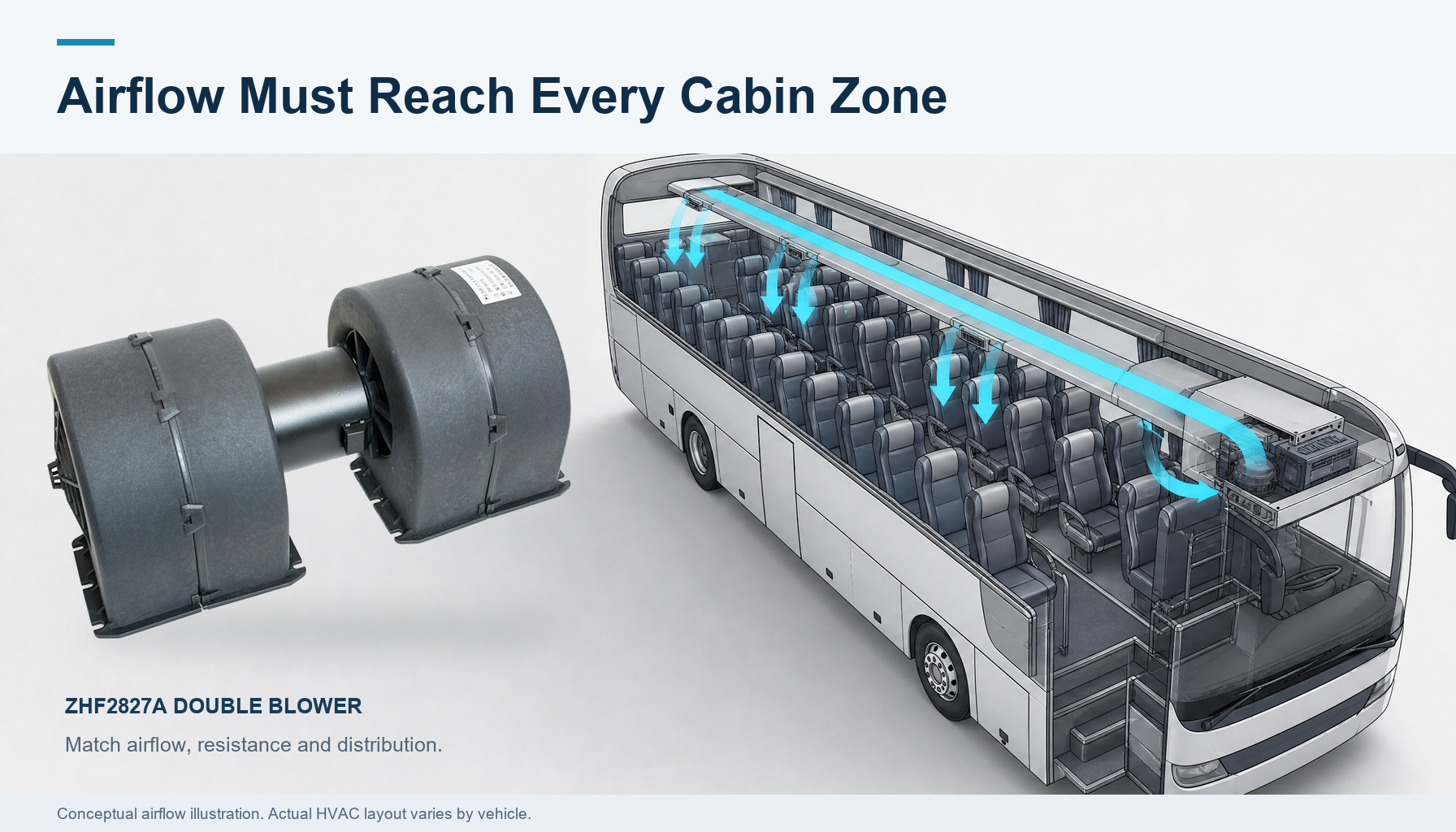
A long passenger compartment and a spacious equipment cab create different distribution problems. Before selecting a blower, document the occupied zones, outlet positions, return-air path and fresh-air requirement. Have the HVAC designer establish the required supply airflow alongside the cooling load and operating conditions. Cabin volume alone does not determine an appropriate blower size, and recirculated supply airflow should not be treated as a fresh-air ventilation rating.
When evaluating our vehicle air-conditioning blowers, define airflow where occupants need it. For a bus layout, specify the airflow required at the rear outlets as well as at the evaporator discharge. For an equipment cab, show the seat position, glazing and available intake clearance. These inputs help determine whether a candidate such as ZHF2827A deserves further evaluation; they do not establish fit by themselves.
Read high air volume together with static pressure
Filters, evaporator coils, bends and narrow passages resist airflow. As ebm-papst's fan selection guidance explains, the installed operating point occurs where the fan curve meets the system curve. Compare candidates at the required airflow and pressure, with consistent test conditions. A maximum free-air value describes a different condition from a pressure-rated duty point.
For example, our ZHF2827A bus evaporator double blower has the following published specification set. Keep these values together when preparing a shortlist rather than transferring the airflow figure to a different voltage or installation.
| Parameter | Published value | What to check |
|---|---|---|
| Test voltage | 27 V | Performance at the vehicle's actual supply range |
| Static pressure | 100 Pa | Pressure required by the complete HVAC air path |
| Air volume | ≥1100 m³/h | Required installed airflow and test configuration |
| Current | ≤13.0 A | Running and starting demands on the vehicle circuit |
| Speed | 4100 ±200 rpm | Applicable speed setting and control arrangement |
This specification block supports an initial comparison, but it cannot describe performance across every duct restriction. Ask for the full curve and measurement setup before approving a duty point above or below 100 Pa. If the installation needs more pressure, do not extrapolate the published airflow. Check the candidate against the revised system requirement.
The ZHF2317 evaporator blower offers another starting point, with published air volume ≥800 m³/h at 100 Pa and test voltages listed as 27 V/13.5 V. Confirm the exact voltage variant and its associated data before comparing it with ZHF2827A. The larger airflow number does not determine the better choice when the installation envelope or available electrical capacity differs.
Check the installation before increasing blower capacity
A high-output blower needs adequate inlet clearance and an outlet connection that suits the duct. ebm-papst identifies restricted installation space as a cause of higher pressure loss, noise and power requirements. Review tight bends, abrupt transitions and obstructions near the blower before specifying an upgrade. Improving a restrictive passage may be more appropriate than increasing motor output.
For ZHF2827A, the published ≤13.0 A value is a reference for electrical review, not a complete circuit design specification. Confirm current across the intended operating range, starting behavior, connector pinout and speed-control requirements. Check these against the vehicle harness, controller and protection design. Obtain the installation drawing to verify mounting points, outlet orientation, sealing and service access before treating any similarly sized blower as interchangeable.
For a long cabin, consider whether separate supply zones would address weak airflow at distant seats. Extra blower units introduce additional wiring, mounting and balancing work, and their catalog airflow values cannot simply be added to predict installed delivery. When evaluating multiple Weili evaporator blowers, provide the shared plenum and branch layout and request data appropriate to that arrangement.
Validate delivery through the complete HVAC assembly
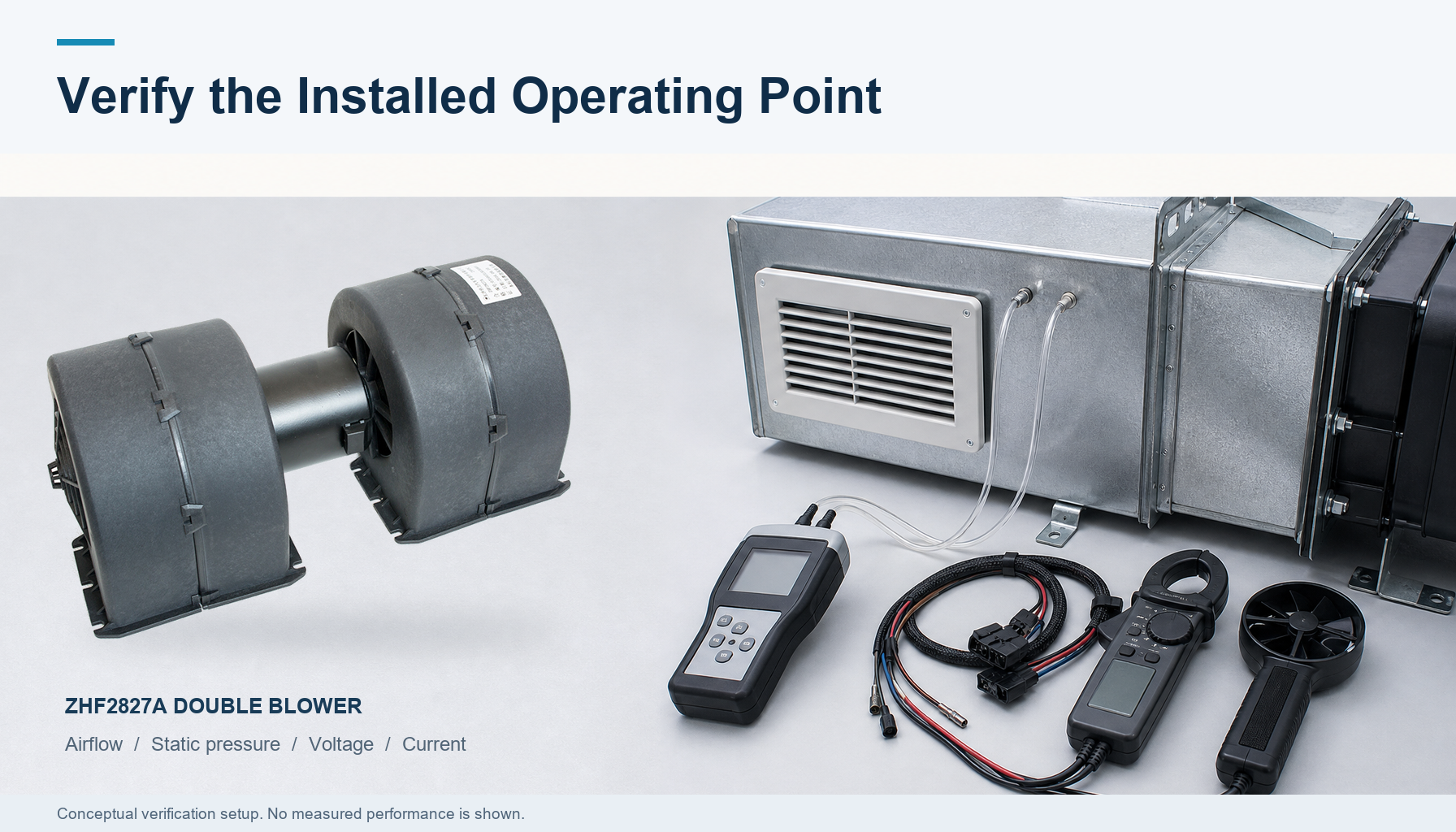
A candidate such as ZHF2827A should be assessed with the intended evaporator, filter, housing and ducts in place. Agree on acceptance criteria before the vehicle trial so that a strong airflow reading at the blower outlet cannot mask weak delivery farther into the cabin. Use the following sequence as a validation plan, with limits set by the vehicle or HVAC project.
- Record the test configuration, blower setting and voltage at the motor terminals. Measure current under the same conditions used for airflow assessment.
- Measure pressure and airflow with a documented method. Identify the pressure measurement locations and include the intended fresh-air and recirculation settings.
- Check outlet delivery across the occupied zones, especially the longest duct runs. Investigate leaks, blocked returns and branch imbalance before rejecting the blower.
- Evaluate cabin temperatures and occupant-area noise against agreed project criteria. Keep the evaporator and refrigeration operating conditions recorded so that a cooling problem is not attributed to airflow without evidence.
- Assess the filter condition and supply-voltage limits specified for the application. Recheck distribution and current wherever those conditions change the intended operating point.
Keep the resulting measurements tied to the exact Weili model and electrical variant. If the target is missed, send the measured voltage, pressure, total airflow and outlet readings with the duct layout. That record makes it possible to distinguish a candidate requiring a different operating point from an installation needing better airflow distribution.
Prepare an application specific blower inquiry
To evaluate our evaporator blower range for a large cabin, send the vehicle type, required supply airflow at pressure, actual supply-voltage range, available installation envelope and allowable current. Include the duct layout, fresh-air setting, connector and control requirements, plus any environmental or acoustic acceptance criteria. For replacement work, add the existing part number and mounting photographs.
Contact Weili with your blower application requirements and identify the candidate model. Request the corresponding performance curve, installation drawing and electrical details before placing an order based on the published airflow alone.
FAQ
Can one ZHF2827A blower serve an entire large cabin
Its published ≥1100 m³/h value at 100 Pa does not establish a cabin-size limit. Suitability depends on the required installed airflow and distribution through the actual HVAC layout. Send the cabin and duct arrangement, target airflow-pressure point and supply data through our contact page for model-specific confirmation.
Can a 27 V test value be used for every 24 V vehicle
A nominal vehicle voltage and a product test voltage describe different conditions. ZHF2827A is tested at 27 V; that single value does not establish airflow throughout a vehicle's supply range. Ask for performance at the expected motor-terminal voltages and confirm the applicable electrical version. For ZHF2317, also clarify the variant corresponding to the listed 27 V/13.5 V data.
Can multiple Weili blowers be used for separate cabin zones
This is a layout option to evaluate, rather than a guaranteed airflow multiplier. Our evaporator blower category provides candidate products; the project still needs confirmation of each unit's operating point, combined current demand, control arrangement and delivery to its assigned outlets. Provide a diagram showing shared and separate air passages.
What should be confirmed before replacing an existing blower
Match the required airflow-pressure point, voltage and control interface, then verify the drawing, rotation, connector and housing connections. A Weili model with a suitable published airflow is only a candidate until these details agree. Include operating hours, dust or moisture exposure and noise criteria in the inquiry, and request the relevant evidence instead of assuming those ratings from the product name.