
 EN
EN ES
ES PT
PT RU
RU AR
AR KO
KO MY
MY FIL
FIL BE
BE
Variable-Speed vs. Fixed-Speed AC Blower Motors: Which Fits Your Bus or Truck?
Choose a fixed-speed blower when the vehicle has one stable airflow target, simple controls, and a service network that values fast, low-complexity replacement. Choose stepped multi-speed or continuously variable control when the bus or truck needs meaningfully different airflow levels for pull-down, normal operation, defrost, low-noise running, or changing passenger loads. The variable option is worthwhile only when the vehicle controller, wiring, diagnostics, and replacement process can support it.
The motor label alone does not answer the question. “Brushless,” “multi-speed,” and “variable-speed” describe different characteristics, and suppliers do not always use those terms consistently. Compare the complete blower assembly at the required static pressure, then verify how speed is commanded and what happens if the control signal fails.
First, separate fixed, multi-speed, and variable-speed
A fixed-speed blower runs at one intended operating speed whenever it is energized. A stepped multi-speed blower provides a limited set of selectable operating points, often through resistors, separate windings, relays, or an electronic controller. A continuously variable blower accepts a command that adjusts speed across a defined range.
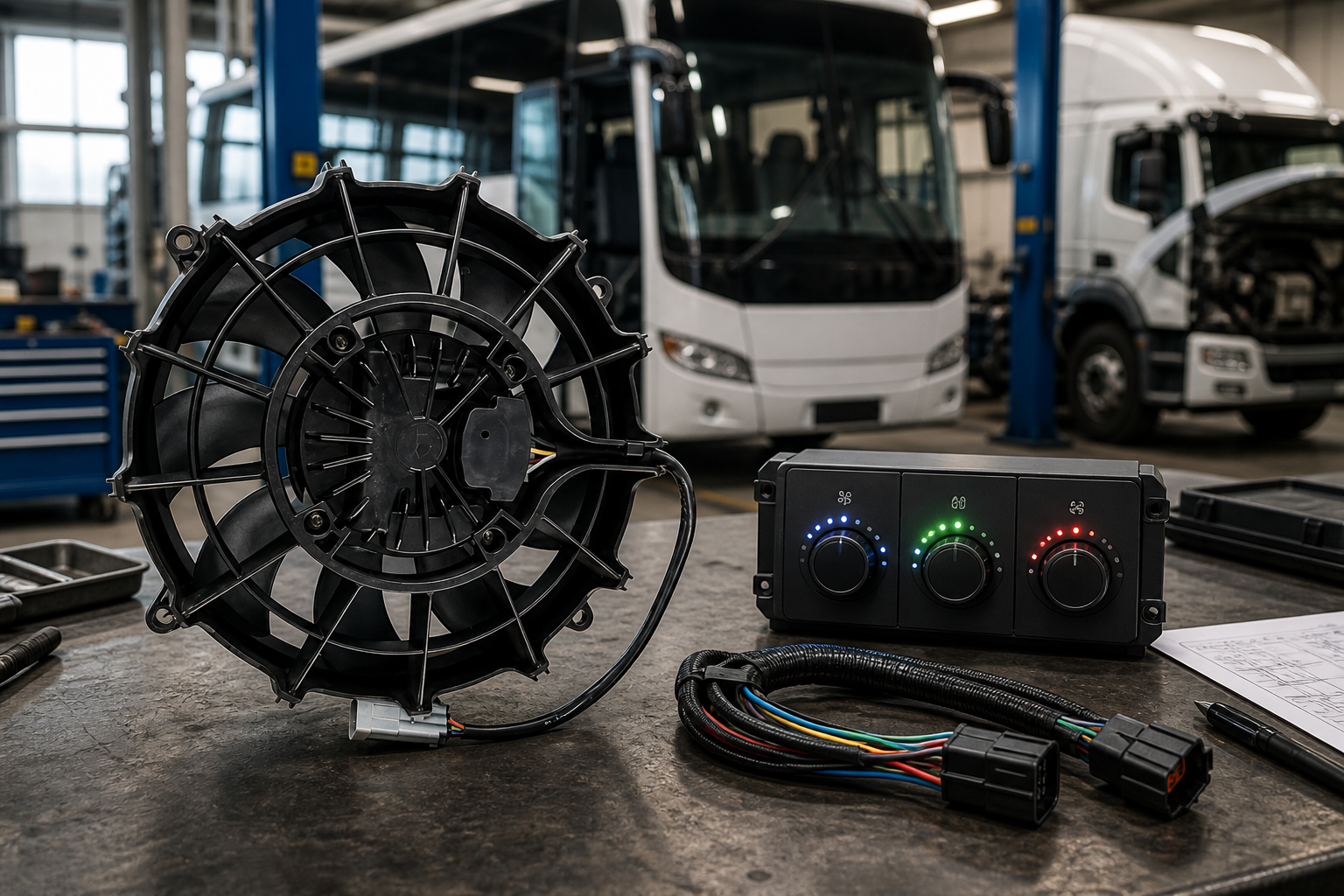
These categories overlap with motor construction, but they are not the same thing. A brushed motor can be used with stepped speed control. A brushless motor may contain electronics yet still be supplied for one operating point. Before treating any BLDC blower as variable-speed, request the command type, permitted range, pinout, controller requirements, and fault behavior.
Selection boundary: buy the control architecture the vehicle can actually command and service. Do not pay for variable capability that the harness, HVAC controller, or maintenance process cannot use.
Use the same criteria for every option
| Decision criterion | Fixed single-speed | Stepped multi-speed | Continuously variable |
|---|---|---|---|
| Best fit | One repeatable airflow target and simple on/off control | A few distinct modes such as low, medium, high, and defrost | Airflow must respond smoothly to temperature, passenger load, noise target, or energy limits |
| Control integration | Lowest; usually power switching and protection | Moderate; needs defined steps, resistor or controller logic, and compatible switching | Highest; needs a documented command signal, electronics, protection, and diagnostics |
| Cabin behavior | Full designed airflow whenever active | Discrete airflow and noise choices | Smooth airflow changes when the control system is correctly calibrated |
| Service and replacement | Easiest to standardize when physical and electrical fit are documented | Requires matching the speed-control method and each operating step | Requires matching motor, controller, command, pinout, software logic, and fail-safe response |
| Main risk | Compromise between high-load airflow and part-load noise/current | Failed resistor or switching element can remove one or more speed steps | An electronically compatible-looking motor may not understand the vehicle's command or diagnostics |
This comparison is about the installed system, not a universal ranking. A well-sized fixed-speed blower is a better decision than a variable unit that cannot communicate with the truck controller. Conversely, a fixed blower may be a poor fit for a large bus that needs quiet part-load operation and rapid airflow during door-open recovery.
Choose fixed speed when simplicity is a real requirement
Fixed speed suits vehicles with a narrow, repeatable duty cycle: a truck cab with one main cooling mode, an auxiliary evaporator that is normally either on or off, or a fleet that prioritizes common spares and straightforward electrical diagnosis. The benefit is fewer control dependencies. Technicians can focus on supply voltage, relay operation, current, rotation, and airflow.
The trade-off appears when one speed must cover several conditions. Size it for peak pull-down and it may be louder than needed during steady operation. Size it for normal running and it may recover too slowly after a bus door cycle or a heat-soaked restart. Decide whether that compromise is acceptable using measured vent airflow, cabin temperature recovery, and driver/passenger noise at the installed point.
Choose stepped multi-speed when a few modes solve the problem
Stepped control is often the practical middle ground. It provides distinct airflow levels without requiring a fully variable command system. A bus can use high speed for initial pull-down or defrost and a lower step for normal passenger comfort. A truck sleeper HVAC unit can offer usable low-noise operation while retaining a strong recovery setting.
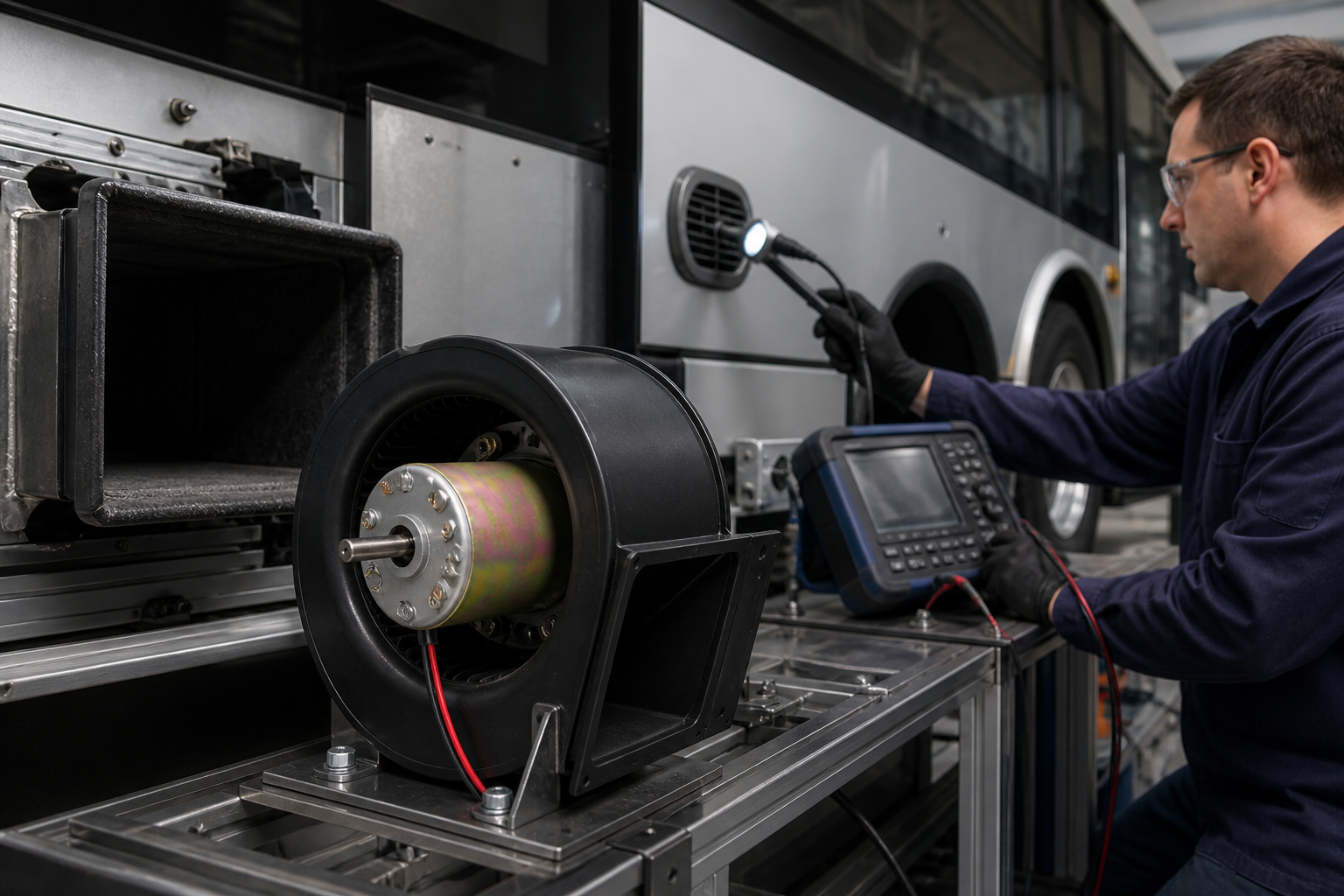
Do not assume “four-speed” means four complete, independently verified blower curves. Weili's public evaporator blower category includes a 24V four-speed truck blower listing, but the public category page does not provide the control circuit, airflow, current, or static-pressure point for every step. A buyer should request those values, the switching method, resistor or module details, and the approved wiring diagram before comparing it with another multi-speed product.
Choose continuous variable speed when control flexibility earns its complexity
Continuous variable control fits applications where airflow should track changing conditions rather than jump between a few modes. Examples include long coaches with changing passenger loads, vehicles with automatic climate control, or installations where reducing blower speed during steady operation materially improves cabin noise or electrical headroom.
The added electronics create a stricter compatibility requirement. The buyer needs to know whether the command is PWM, analog voltage, LIN, CAN, or another interface; the accepted frequency or voltage range; the relationship between command and speed; whether feedback is available; and how the blower behaves if the signal is missing or invalid. None of those details should be inferred from a “brushless” product title.
Variable speed is also a service decision. If a vehicle is stranded by a controller mismatch that local technicians cannot diagnose, smoother airflow does not compensate for the downtime. Confirm diagnostic tools, replacement programming or calibration, fault codes, connector pinout, and emergency fallback before standardizing the design across a fleet.
Compare airflow at static pressure, not motor type
The evaporator coil, filter, inlet, ducts, bends, and outlet grilles create resistance. Compare blower candidates at the pressure the installed system will impose. A free-air figure does not show how much air reaches the cab or passenger compartment.
Weili's ZHF2317 gives a useful fixed operating-point example: the public product page states test voltage of 27V/13.5V, current no more than 6.0A/14.0A, speed of 3,600 +/- 200 rpm, static pressure of 100 Pa, and airflow of at least 800 m3/h. The ZHF2101W brushless listing states 26V, current no more than 12.5A, 100 Pa, and airflow of at least 1,000 m3/h. These are different products, not a controlled efficiency comparison. Their value here is to show the test conditions that should accompany any airflow claim.
Request this data for each commanded speed
- Airflow at the required static pressure
- Supply voltage and current at the operating point
- Motor or blower speed and permitted tolerance
- Noise test position and installation condition
- Temperature, protection, and duty-cycle limits
- Control command, connector pinout, and failure response
If the supplier provides only maximum airflow and nominal voltage, the comparison is incomplete. Ask for a curve or agreed test points using the same pressure basis for all candidates.
Check the vehicle's electrical and control architecture
Confirm nominal voltage, operating-voltage range, continuous and starting current, wire gauge, fuse, relay or controller rating, connector, polarity, and voltage drop under load. A 24V label does not prove that the blower is compatible with a vehicle charging at a higher operating voltage, nor does it show whether the existing harness can carry the current.
For fixed and stepped systems, identify whether speed is controlled on the power side, ground side, through resistors, separate leads, or an electronic module. For continuous variable systems, document the command source and signal. Weili's public DC motor category confirms 12V/24V bus, truck, and van applications, but product-specific control-interface information still needs to be confirmed for the selected motor.
Account for bus and truck operating differences
A city bus sees frequent door openings, changing passenger load, long idle periods, and a large air distribution network. Variable or stepped speed may support strong recovery and quieter steady operation, provided the HVAC controller and service network can support it. The buyer should test the rear and front passenger zones instead of relying on the outlet nearest the evaporator.
A long-haul truck cab or sleeper usually has a smaller conditioned volume but tighter electrical and acoustic constraints during rest periods. Low-speed control may improve comfort, while a simple fixed-speed auxiliary system may be easier to support across remote service locations. The route, idle policy, alternator margin, sleeper use, and parts availability should drive the choice.
Engineering vehicles add dust, vibration, restricted packaging, and irregular duty cycles. Here, housing sealing, connector retention, motor cooling, and service access may disqualify a theoretically attractive control strategy. Weili's vehicle application page identifies buses, heavy transport, engineering vehicles, and large vehicles as relevant use environments, but the exact blower selection still requires vehicle-level data.
Use a representative-vehicle test before fleet approval
- Record ambient temperature, humidity, solar load, passenger or simulated heat load, starting cabin temperature, and door-opening pattern.
- Measure voltage and current at each available speed while the blower is installed.
- Measure vent airflow or a repeatable proxy at the same outlets for every operating mode.
- Record cabin pull-down and steady-state temperature at idle and representative road speed.
- Check noise, vibration, connector temperature, control stability, and evaporator icing.
- Disconnect or invalidate the speed command only under an approved test procedure and confirm the documented fail-safe behavior.
- Ask fleet technicians to replace or diagnose the unit using the intended service documents before approving bulk purchase.
The pilot should answer two different questions: does the blower meet the thermal and acoustic target, and can the fleet support it after warranty or outside the main depot? A design can pass the first test and fail the second.
Send suppliers a control-focused inquiry
| Information to provide | Confirmation to request |
|---|---|
| Vehicle model, HVAC unit, voltage, cab or passenger volume, duty cycle, and annual quantity | Recommended blower model and stated fitment limits |
| Required airflow range and estimated or measured static pressure | Airflow, current, and speed at each relevant operating point |
| Existing wiring, connector, controller, resistor/module, and speed commands | Pinout, command type and range, feedback, protection, and fail-safe response |
| Housing drawing, rotation, inlet/outlet orientation, mounting, and clearance | Dimensional drawing and any installation changes |
| Noise target, ambient environment, vibration, dust, and service network | Test conditions, application limits, diagnostic process, and replacement procedure |
Request a blower control and fitment review
Send Weili the vehicle voltage, blower housing details, required airflow and static pressure, current speed-control method, connector information, and operating profile. The team can identify relevant brushed or brushless blower options and mark the control details that still require confirmation.
Request a blower fitment reviewFAQ
Is a brushless blower always variable-speed?
No. Brushless describes the motor construction. Variable-speed describes how its operating speed can be commanded. Request the control interface, command range, wiring, feedback, and failure behavior for the exact blower.
Is a four-speed blower the same as a continuously variable blower?
No. A four-speed blower provides four defined steps. A continuously variable blower accepts a command across a stated range. The stepped option may be easier to integrate when the vehicle already uses relays, resistors, or a compatible speed module.
Which blower type uses less electrical power?
Do not decide from the type label. Compare current and airflow at the same installed static pressure and at the speeds the vehicle will actually use. A variable blower can reduce input at lower commanded airflow, but the operational result depends on controller strategy, system resistance, and duty cycle.
Can I replace a fixed-speed blower with a variable-speed model?
Only after confirming mechanical fit, voltage, current, connector, command signal, controller compatibility, protection, and fail-safe behavior. Without a compatible command source, the new blower may run incorrectly or not run at all.
Select fixed speed for a stable airflow target and service simplicity. Select stepped multi-speed when a few defined operating modes cover the vehicle. Select continuous variable control when smooth airflow adjustment solves a measured comfort, noise, or electrical constraint and the fleet can support the added controls. In every case, approve the blower from installed airflow and control compatibility, not the motor label.