
 EN
EN ES
ES PT
PT RU
RU AR
AR KO
KO MY
MY FIL
FIL BE
BE
5 Heavy-Duty Truck AC Compressor Configurations for Extreme Weather
There is no defensible universal top-five compressor ranking for every heavy-duty truck and climate. The best configuration is the one that matches the original refrigerant circuit, mounting and drive system, control strategy, cooling load, and worst operating condition. For most fleets, the five useful options are: an exact OE-spec belt-driven replacement, a reinforced severe-duty belt-driven unit, an electronically controlled variable-displacement unit, a high-voltage electric compressor for a hybrid or battery-electric platform, and a separate auxiliary compressor for engine-off sleeper cooling. Start with the vehicle architecture; extreme-weather claims come second.
A compressor can have a strong heavy-duty reputation and still be wrong for the truck. Port orientation, mounting ears, displacement, pulley geometry, clutch voltage, belt alignment, refrigerant, oil, controller logic, speed envelope, and condenser capacity must work as one system. Extreme heat, cold starts, dust, vibration, long idle periods, and engine-off duty expose a mismatch faster, but they do not make basic compatibility optional.
Selection boundary: do not order from a photo, brand name, or nominal displacement alone. Match the complete compressor specification and validate the condenser, airflow, lubrication, drive, and control system that will support it.
What qualifies a compressor for extreme weather?
Extreme heat raises the demand on the entire heat-rejection path, especially during idle, traffic, and low-speed work when road airflow is limited. A larger compressor cannot compensate for a blocked condenser, weak condenser fan, recirculating hot air, or an undersized heat exchanger. It may instead increase high-side stress. Before increasing capacity, confirm that the condenser and fan can reject the added heat at the installed operating point.
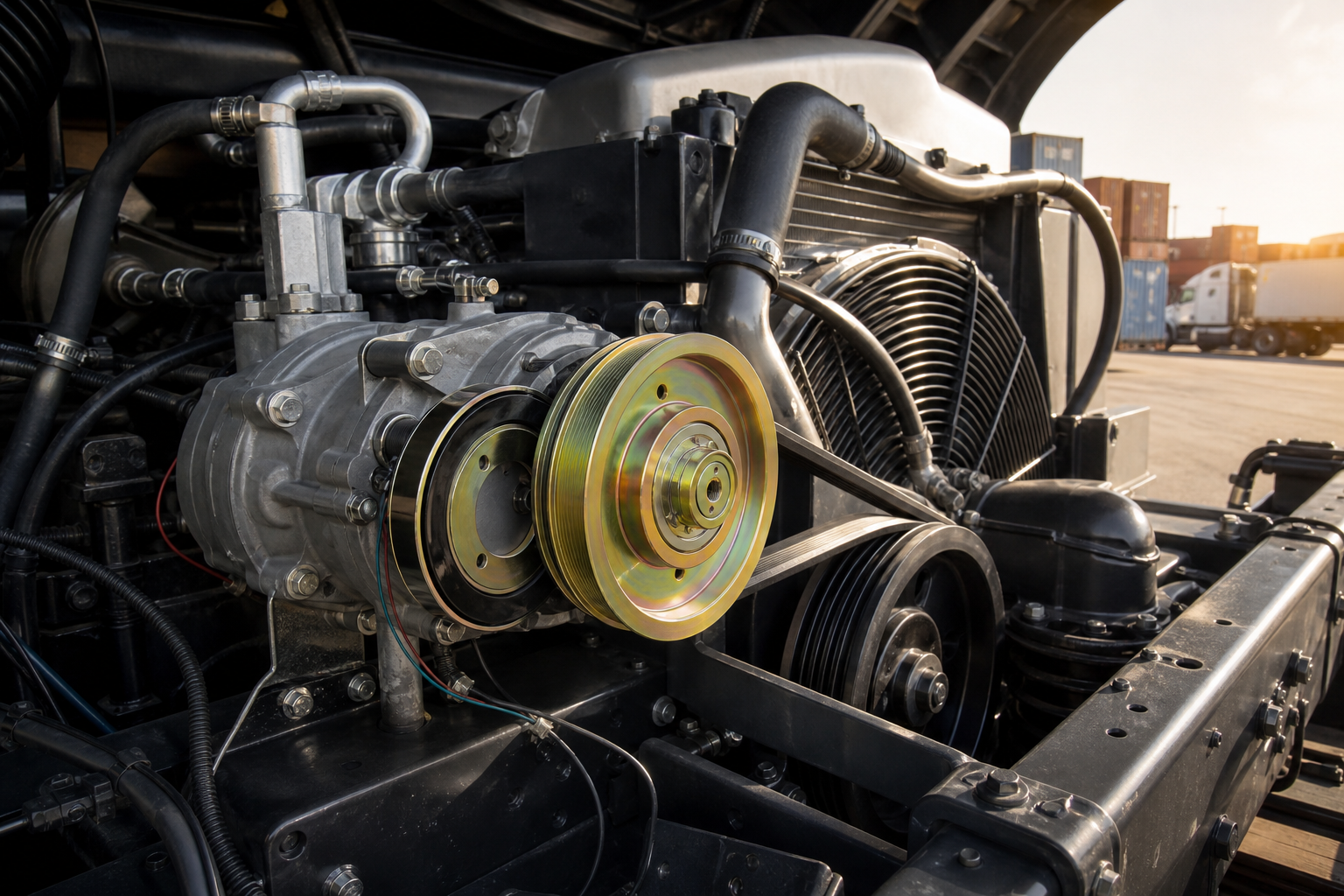
Cold-weather risk appears differently. Oil circulation, refrigerant distribution, seal condition, clutch engagement, belt behavior, and control logic must remain acceptable after the vehicle has soaked at its lowest operating temperature. A generic "all-weather" label is not evidence. Ask for the approved temperature range, oil and refrigerant pairing, startup limitations, and the supplier's validation method for the exact model.
Dust, road salt, water, vibration, and long duty cycles affect connectors, bearings, clutch surfaces, mounting brackets, and heat exchangers. For these fleets, environmental protection and mechanical installation matter as much as compressor architecture. Request model-specific evidence rather than assuming that a heavy casting or a familiar brand proves suitability.
Five configurations worth comparing
| Configuration | Best fit | Main trade-off | Disqualifying mismatch |
|---|---|---|---|
| 1. Exact OE-spec belt-driven replacement | Existing truck system with known part number and no planned architecture change | Lowest integration risk, but no automatic increase in severe-duty margin | Different ports, mount, pulley, clutch, displacement, oil, refrigerant, or rotation |
| 2. Reinforced severe-duty belt-driven | High vibration, long duty cycle, severe environment, or a validated heavy-duty upgrade path | Potential durability margin must be supported by model-specific fit and evidence | "Heavy duty" label without a verified application, mounting match, or system approval |
| 3. Electronically controlled variable-displacement | Truck originally designed to command compressor output across changing load | Load control can improve system behavior, but electronics and calibration add dependencies | Vehicle controller, valve, signal, connector, or diagnostic logic is incompatible |
| 4. High-voltage electric compressor | Hybrid or battery-electric truck with an electrically driven thermal system | Independent of engine speed, but requires high-voltage, inverter, oil, isolation, and control compatibility | Voltage class, communications, refrigerant oil, insulation, or thermal-management logic does not match |
| 5. Separate auxiliary or parking compressor | Sleeper or engine-off cooling with a dedicated auxiliary circuit | Reduces reliance on engine operation, but adds electrical load, components, packaging, and service scope | Battery capacity, charging strategy, condenser airflow, or runtime target is unverified |
1. Exact OE-spec belt-driven replacement
This is the default choice when the truck already has a proven HVAC design and the objective is to restore performance. Start with the OE compressor number and vehicle application, then verify supersessions through an authoritative catalog. Compare the complete data set: mounting pattern, body clearance, suction and discharge ports, displacement, rotation, pulley diameter and grooves, clutch coil voltage, connector, refrigerant, oil type and charge, and any manifold or sensor arrangement.
The advantage is controlled change. Existing brackets, hoses, belt routing, controller logic, and service procedures remain valid when the replacement is truly equivalent. The limitation is equally clear: an exact replacement does not solve a weak condenser fan, contaminated circuit, wrong charge, worn tensioner, or repeated loss of lubrication. Correct the cause of the previous failure before commissioning the new unit.
DENSO's official medium- and heavy-duty compressor page confirms a commercial-vehicle replacement range and directs buyers to application lookup. That is the right procurement pattern: identify the truck and exact part application first, then evaluate severe-weather operation inside the approved system boundary.
2. Reinforced severe-duty belt-driven compressor
Consider a severe-duty model when the vehicle works in sustained vibration, high heat, dust, long daily cycles, or another environment covered by the compressor manufacturer's application guidance. Sanden's official heavy-duty range identifies SHD and SSHD product types for harsh environments, while its Super Heavy Duty compressor page describes an SHD SD7 configuration for severe applications and notes that its mounting features and body diameter match the SD7H15.
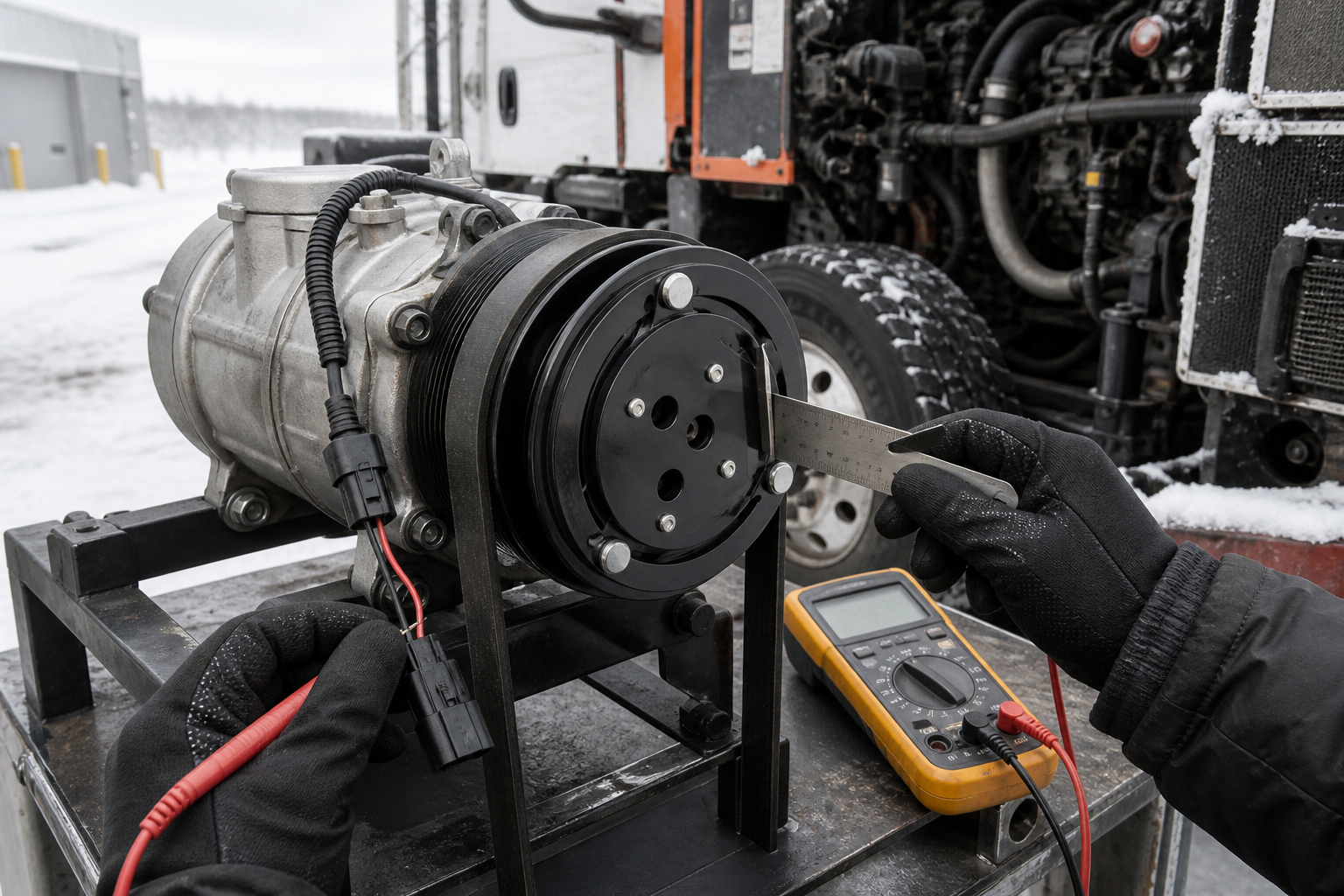
That public statement supports one upgrade path, not a universal interchange. The clutch, head, ports, pulley, displacement, refrigerant circuit, bracket, and vehicle application still need confirmation. Ask the manufacturer or authorized supplier which internal changes define the severe-duty model, which operating conditions were tested, and whether the exact truck application is approved.
The trade-off is between added severe-duty design margin and uncontrolled substitution. If the system cannot reject heat, maintain oil return, or keep the belt aligned, a tougher compressor may only delay another failure. Pair the compressor review with condenser airflow, circuit cleanliness, hose routing, mounting stiffness, and drive-system inspection.
3. Electronically controlled variable-displacement compressor
This configuration belongs in trucks designed to modulate compressor output rather than cycle a simple clutch at one fixed displacement. It can respond to changing cabin load and operating conditions, but the control valve, command signal, software calibration, pressure sensing, and diagnostic strategy become part of compatibility. A compressor that bolts on but cannot interpret the vehicle command is not a valid replacement.
Use the original compressor code and vehicle service information to identify the control method. Request the valve or actuator specification, connector and pinout, command range, fail-safe behavior, displacement range, approved refrigerant and oil, and diagnostic procedure. Do not convert a fixed-displacement system to variable control, or the reverse, without an engineered system plan.
For extreme heat, the benefit is not a generic promise of more cooling. The value is controlled capacity when the original HVAC controller, condenser, evaporator, and engine-management system were designed around it. In cold conditions, the same rule applies: follow the platform's protection and enable logic rather than bypassing it with a direct electrical command.
4. High-voltage electric compressor
A high-voltage electric compressor is the correct architectural family for hybrid and battery-electric trucks whose thermal management is independent of engine belt speed. It may support cabin cooling while stationary and can be coordinated with battery or power-electronics cooling, but only within the vehicle's designed high-voltage and control system.
Do not treat voltage as the only selection field. Confirm DC voltage range, peak and continuous electrical demand, inverter integration, communication protocol, connector and shielding, electrical isolation requirements, refrigerant, electrically compatible oil, speed and capacity maps, cooling method, ingress protection, mounting orientation, and fault strategy. Service work also requires the vehicle manufacturer's high-voltage procedures and qualified personnel.
The extreme-weather constraint moves upstream to energy and thermal management. In very hot conditions, the compressor, condenser fans, battery, and power electronics may compete for electrical and cooling capacity. At low temperature, the vehicle may use a different thermal strategy. Validate the complete operating modes and derating behavior; a standalone compressor rating cannot predict vehicle-level performance.
5. Separate auxiliary or parking compressor
Choose a separate auxiliary compressor when the primary requirement is sleeper cooling or cabin conditioning with the engine off. This is an additional HVAC architecture, not a direct replacement for the engine-driven compressor. The auxiliary circuit may be self-contained or integrated, and that distinction controls refrigerant plumbing, condenser placement, controls, and service responsibility.
Begin with the required cabin condition and runtime, then calculate the electrical and heat-rejection budget with the system supplier. Confirm battery capacity at the relevant temperature and state of charge, charging strategy, compressor demand, condenser-fan demand, low-voltage cutoff, expected duty cycle, installation envelope, drainage, vibration, and noise. A long runtime claim without stated test conditions is not useful evidence.
The trade-off is engine-off capability against added system complexity. A dedicated auxiliary unit adds a compressor, condenser, evaporator or heat exchanger, wiring, controls, and maintenance points. It is justified when idle reduction or sleeper operation is a defined fleet requirement and the truck's energy system can support the validated runtime.
The compressor is only one part of extreme-weather performance
High ambient performance depends on condenser heat rejection. Inspect fin condition, contamination, fan direction, loaded fan voltage, shrouding, air recirculation, and airflow at low vehicle speed. A compressor selected for higher capacity can raise the condenser burden. Approve the combination using system pressures, temperatures, vent pull-down, fan current, and the truck manufacturer's limits under a representative heat-soak and idle cycle.
Lubrication and cleanliness decide whether a replacement survives. Determine why the previous compressor failed, follow the compressor and vehicle manufacturer's flushing or component-replacement procedure, use only the approved refrigerant and oil, measure the oil charge by the specified method, replace required filters or driers, evacuate correctly, and prevent contamination during assembly. Do not copy a generic oil quantity from another compressor family.
On a belt-driven system, verify the complete mechanical drive: bracket condition, alignment, pulley grooves, belt length, tensioner travel, clutch air gap where specified, coil voltage, connector, and engagement under load. Weili Automotive's public Other Parts category lists compressor clutches for named bus HVAC applications. These are clutch components, not complete compressors, and compatibility must be confirmed by compressor model, pulley geometry, voltage, and application.
What to include in a compressor RFQ
- Truck make, model, year, engine or electric platform, VIN or fleet identifier, and original compressor number.
- Operating region, maximum and minimum expected ambient conditions, altitude, dust, salt, vibration, idle time, route profile, and daily AC duty cycle.
- Refrigerant, oil specification, original oil quantity or service method, circuit layout, condenser and evaporator details, and hose or manifold arrangement.
- Mounting pattern, body envelope, port type and orientation, rotation, drive ratio, speed range, pulley diameter and grooves, belt, tensioner, and bracket information.
- Clutch voltage and connector, or control valve, high-voltage, inverter, command, communication, and diagnostic information for electronically controlled units.
- Requested capacity or performance map at stated conditions, approved application evidence, environmental and vibration test information, and installation instructions.
- Failure history, contamination findings, condenser-fan condition, system pressure and temperature data, and corrective work already completed.
- Sample validation plan, acceptance limits, documentation, traceability, change control, packaging, spares, warranty scope, lead time, and MOQ to be confirmed by the supplier.
Confirm the compressor first, then match the clutch
Obtain the compressor model and approved vehicle application from the compressor manufacturer or system supplier. If the belt-driven assembly also requires a replacement clutch, send Weili Automotive the compressor code, pulley diameter and groove profile, clutch voltage, connector, mounting details, and vehicle application through the contact page for a clutch-specific review.