
 EN
EN ES
ES PT
PT RU
RU AR
AR KO
KO MY
MY FIL
FIL BE
BE
The Role of Condenser Fans in Commercial Vehicle AC Systems: Protecting Cooling Performance
A condenser fan protects cooling performance by forcing ambient air through the condenser when road speed cannot provide enough airflow. This matters most in traffic, at idle, during low-speed route work, and around a heat-soaked vehicle. The correct fan is not simply the largest unit that fits. It must deliver adequate airflow against the resistance of the installed heat-exchanger stack, rotate in the correct direction, match the vehicle voltage and control strategy, and cover the active condenser area without allowing air to bypass the core.
A fan that spins can still be the wrong fan. Weak voltage at the connector, incorrect blade rotation, missing shrouding, a blocked condenser, or a replacement selected from free-air volume alone can leave the high side operating under more stress than the system design intended. For buyers and fleet engineers, the useful question is therefore not "Does the fan run?" but "Does the installed fan move the required air through this condenser under the vehicle's worst credible operating condition?"
What the condenser fan changes in the refrigeration loop
Refrigerant leaves the compressor as a hot, high-pressure vapor. The condenser transfers that heat to ambient air so the refrigerant can become a high-pressure liquid before it reaches the expansion device. The fan supplies forced airflow across the condenser fins when natural airflow and vehicle motion are insufficient. If heat rejection falls, high-side pressure can rise, compressor workload can increase, and cabin pull-down can deteriorate.
The effect is easiest to see at low road speed. A vehicle may cool acceptably on the highway because ram air passes through the front heat exchangers, then lose performance in traffic or during extended idle. That pattern does not prove the fan is the only fault, but it makes condenser airflow, fan command, voltage, rotation, shrouding, and core blockage priority checks. An automotive technical review from MOTOR likewise warns that fan operation alone does not prove adequate installed airflow.
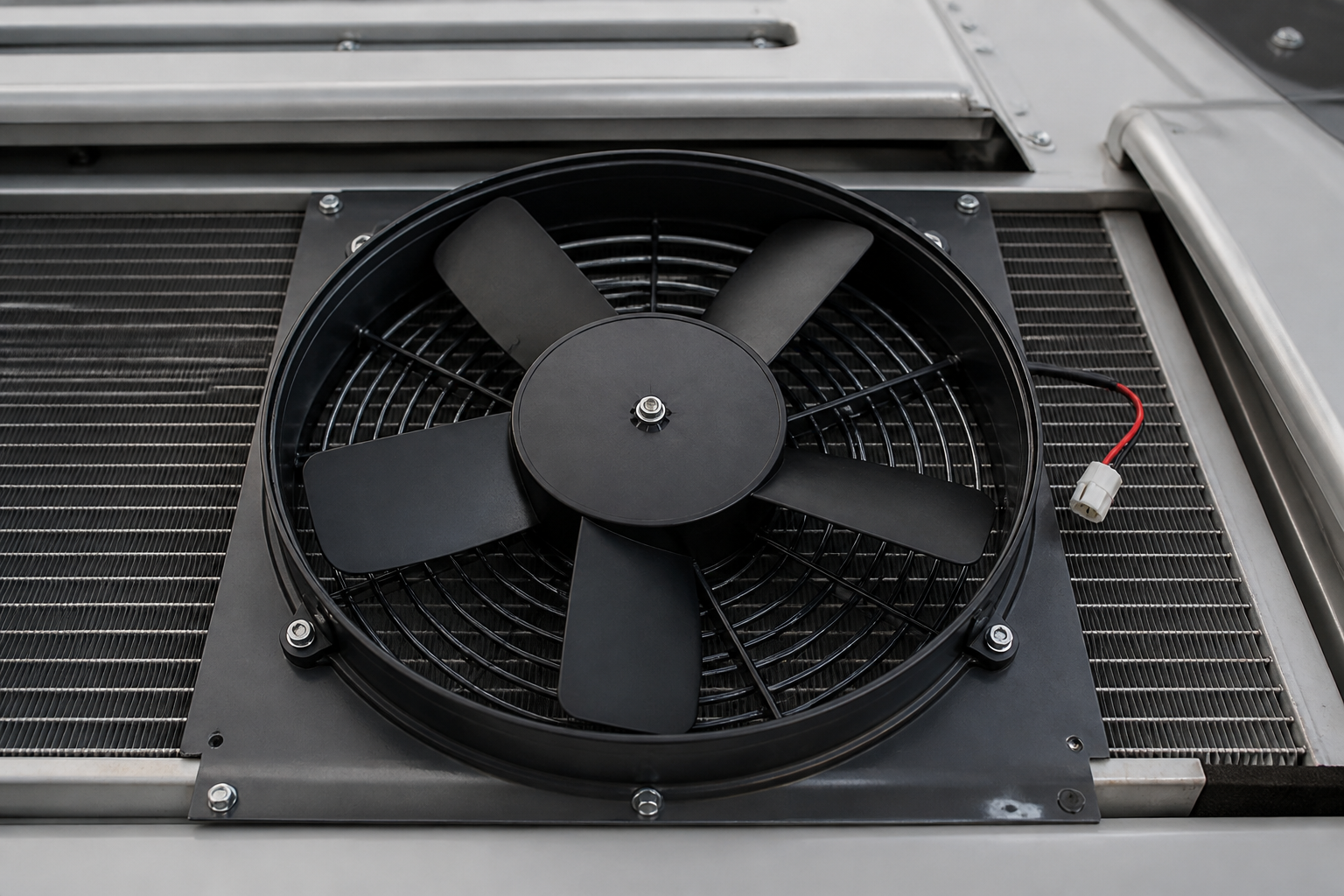
Decision rule: specify the fan as part of the condenser, shroud, grille, radiator, wiring, and control system. A free-air rating without an operating point cannot show how the fan will behave against the resistance of the actual installation.
Read the symptom in context
| Observed condition | Why condenser airflow is relevant | Checks before replacing the fan |
|---|---|---|
| Cooling is better at road speed than at idle | Vehicle motion may be compensating for insufficient forced airflow | Fan command, speed, rotation, supply voltage under load, core blockage, and shroud condition |
| High-side pressure climbs in traffic | Heat may not be leaving the condenser fast enough under low-speed conditions | Compare pressure and temperature behavior with the vehicle service procedure; inspect airflow path and heat-exchanger cleanliness |
| A replacement fan runs but cooling remains weak | Physical fit does not prove airflow, static-pressure capability, polarity, blade orientation, or control compatibility | Confirm part data, installed current, airflow direction, sealing, operating point, and controller command |
| Fan fuse, relay, connector, or wiring runs hot | The electrical circuit may be overloaded or suffering excessive resistance | Measure voltage drop and current under load; verify fuse, relay, conductor, connector, and duty-cycle ratings |
These patterns guide diagnosis; they are not stand-alone proof. Refrigerant charge, condenser contamination, expansion control, compressor condition, sensor inputs, and control logic can produce overlapping symptoms. Use the OEM service method and appropriate pressure and temperature measurements before authorizing a component change.
Specify the installed operating point, not only fan diameter
Diameter controls packaging and potential swept area, but it does not define useful airflow through a condenser. Buyers need the airflow delivered at a stated static pressure because the condenser fins, radiator, guards, grille, filters, ducts, and shrouds resist flow. Two fans with similar dimensions can perform differently once installed against that resistance.
Weili Automotive's public 24V brushless bus condenser fan page provides a useful example of a defined test point: model LNF2201W is listed at a 26V test voltage, current no greater than 13.5A, 100Pa static pressure, and airflow of at least 2500m3/h. Treat those figures as model-specific published data, not as a universal requirement. A valid comparison needs the same voltage, pressure, test setup, and acceptance convention for every candidate.
A complete fan curve is more useful than one test point because the vehicle's actual system resistance determines where the fan operates. When a curve is unavailable publicly, ask the supplier for airflow versus static pressure, input power or current at the required point, and the test standard or fixture. Reject comparisons that place one product's free-air volume beside another product's airflow measured against resistance.
Match airflow direction and installation geometry
A pusher fan mounted ahead of the condenser and a puller fan mounted behind it are not interchangeable merely because their voltage and diameter match. Blade geometry, motor rotation, mounting frame, and airflow direction work together. Reversing polarity may reverse some DC motors, but it does not guarantee that the blade will perform efficiently in the opposite direction or that an electronic motor permits reversal.
Coverage also matters. Air follows the easiest path, so gaps between the fan, shroud, and condenser can allow recirculation or bypass. Ask for the overall envelope, mounting-hole pattern, blade sweep, hub diameter, projection depth, guard arrangement, connector position, and intended push/pull orientation. Then inspect clearance to hoses, structure, the radiator, and service panels throughout vehicle vibration and body movement.
The trade-off is practical: a larger fan or more aggressive blade can increase potential airflow, but it may demand more current, create more noise, reduce clearance, or load the mounting structure. Multiple smaller fans may improve packaging and staged operation, yet add connectors, relays, wiring, and failure points. Choose the architecture against the vehicle duty cycle and service strategy, not a single catalog number.
Check the electrical and control boundary
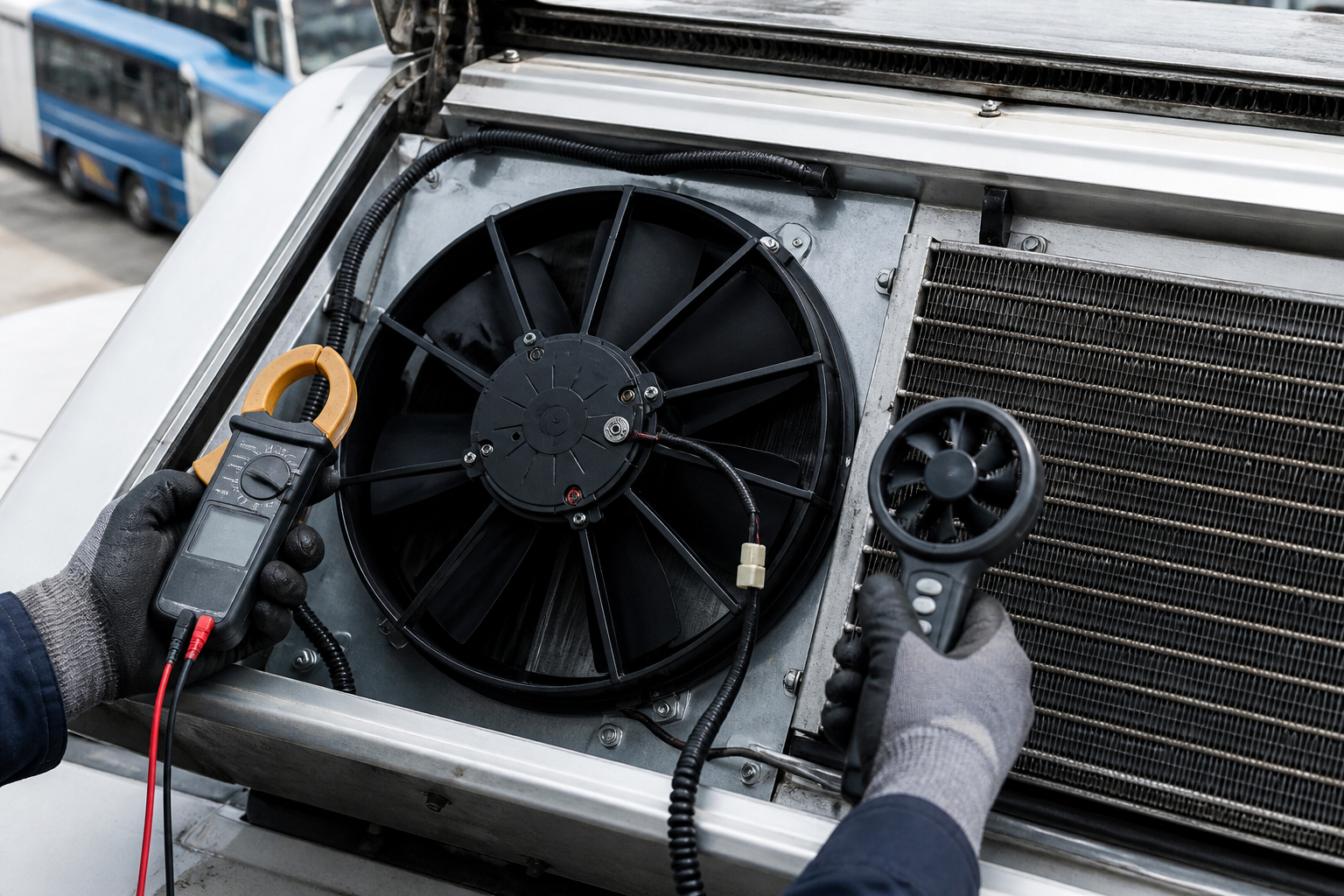
Start with nominal system voltage, then verify the voltage the fan actually sees during operation. Long cable runs, undersized conductors, worn relays, corroded grounds, and connectors with high resistance can reduce motor speed while the fan still appears to run. Record loaded voltage at the fan, current draw, inrush behavior where applicable, fuse and relay ratings, wire size, connector type, polarity, and grounding method.
Control architecture is equally important. The vehicle may use a simple on/off relay, staged fan banks, a pressure switch, a variable-speed module, or an ECU command. "Brushless" does not automatically mean the fan accepts PWM, LIN, CAN, or another variable command. The public Weili category includes both conventional and brushless automotive condenser fan listings, but buyers should request the exact pinout, command type, protection behavior, and fault response for the selected model.
Validate where the vehicle is hardest to cool
Bench confirmation should precede vehicle testing: check dimensions, rotation, airflow direction, connector fit, current, unusual vibration, and guard clearance. Installed validation must then recreate the demanding condition the vehicle actually faces, such as high ambient temperature, extended idle, repeated bus-door opening, low-speed urban work, a dirty-road environment, or simultaneous thermal load from adjacent heat exchangers.
Agree on acceptance criteria before the test. Depending on the vehicle and available procedures, these may include high- and low-side pressure behavior, condenser inlet and outlet temperature, vent temperature pull-down, loaded fan voltage and current, coolant temperature interaction, noise, vibration, and stable operation through repeated cycles. Use the vehicle or HVAC system manufacturer's service limits rather than inventing a generic pressure or temperature threshold.
A sample that passes in open air is not enough. Confirm performance with the production shroud, grille, condenser, radiator stack, wiring length, connector, and control logic. This catches the expensive failures that appear only after installation: wrong rotation, air bypass, voltage drop, resonance, thermal derating, connector heating, and interference with service access.
Send suppliers a complete condenser-fan RFQ
- Vehicle type, HVAC system location, application, operating region, and worst expected ambient and duty cycle.
- Nominal voltage, measured loaded voltage range, control method, connector, pinout, fuse, relay, and wiring information.
- Condenser dimensions, active core area, heat-exchanger stack arrangement, shroud, guard, grille, and available installation envelope.
- Required push or pull direction, airflow direction, mounting-hole pattern, allowable depth, and clearance limits.
- Required airflow at static pressure or the system-resistance information used to select the operating point.
- Current or input-power limit, noise target, vibration exposure, contamination exposure, and required environmental protection.
- Requested fan curve, test conditions, dimensional drawing, wiring diagram, material and protection details, inspection evidence, and change-control process.
- Sample quantity, vehicle validation plan, acceptance criteria, packaging needs, spare-parts plan, and documentation required with production orders.
Do not assume that an online product name proves vehicle compatibility. Weili's application page confirms that its range includes condensing fans for automotive and commercial-vehicle uses, while individual suitability still depends on the model and installed conditions. The RFQ should make those conditions visible before a quotation or sample is approved.
Review a condenser-fan requirement with Weili
Send the vehicle application, voltage and control method, condenser and shroud dimensions, required airflow operating point, mounting details, and expected duty cycle. Use Weili Automotive's contact page to request a model-specific specification and compatibility review before ordering samples.