
 EN
 ES
 PT
 RU
 AR
 KO
 MY
 FIL
 BE

Agricultural Machinery AC Solutions: Durable Compressors and Blowers for Tractors
Why tractor cabin cooling is a durability problem first
A tractor is not a car with bigger wheels. Its air-conditioning works in the worst cooling environment most off-road machines ever see: open fields throw fine dust through every gap, engine and hydraulic loads push ambient heat past what a road vehicle meets, the cabin sits low in the dust plume, and the machine idles for hours at a time under power take-off (PTO) work. On top of that, the electrical supply is rarely clean — alternator ripple, long harness runs, and voltage swings from a slow, loaded engine all stress the compressor clutch and the blower motor. When the cabin AC fails on a 38°C afternoon, the operator loses focus, productivity drops, and a simple part becomes a whole-day stoppage. That is why "durable" has to mean more than a longer warranty on paper — it has to mean components that survive dust, vibration, heat, and unstable voltage. This guide is written for agricultural machinery OEMs, tractor dealerships, and fleet and rental operators who specify or replace cabin AC compressors and blowers, and it keeps the selection decision evidence-based rather than brand-led.
Start with the off-road duty cycle, not the catalogue
Before comparing part numbers, define the duty the tractor actually sees. Four conditions decide whether a compressor or blower will last:
- Dust and ingress. Cabin filters clog fast in agriculture; a starved evaporator then forces the blower to work harder while the compressor runs longer to reach setpoint. Sealed motors and clean airflow paths matter more than a headline airflow number.
- Vibration. Continuous low-frequency shake loosens mounts, fatigues harnesses, and damages clutch air gaps. Component balance and mounting geometry are selection criteria, not footnotes.
- Heat. High under-bonnet and cabin-plenum temperatures raise winding temperature; motor thermal rating and clutch friction tolerance decide summer reliability.
- Electrical instability. A 24 V system on a slow, loaded engine can sag well below nominal and spike with alternator ripple. Components with a wide voltage window and a low starting voltage are far more forgiving in the field.
These four conditions are exactly where tractor cabin AC differs from a bus or truck, even though the underlying compressor-and-blower architecture is similar. Our piece on common commercial-vehicle AC compressor failures shows the same root causes — clutch wear, bearing fatigue, and contamination — appearing first under harsh duty.
Compressors: the clutch, not the pump, is the weak link
Most tractor cabin air conditioners use a belt-driven reciprocating or scroll compressor engaged by an electromagnetic clutch. The pump itself is robust; the clutch — the pulley, bearing, and friction face that connect and disconnect the compressor from the belt — is the part that wears, slips, and fails under dust, heat, and vibration. For a replacement programme, that means the decisive specification is the clutch: pulley diameter, groove type (single or double V-belt), voltage, coil power, and the mounting pattern that must match the tractor's actual AC compressor model.
Weili manufactures 24 V compressor clutches for several major compressor platforms used across transport and mobile-refrigeration air conditioning. The verified options below are the ones to cross-check against the compressor already fitted to the tractor:
| Clutch platform | Voltage / coil | Pulley diameter | Groove | Typical application |
|---|---|---|---|---|
| Thermo King X426 / X430 | 24 V | φ210 mm | 2B | Transport / bus AC compressors |
| Valeo TM65 | 24 V / 60 W | φ260 / φ210 mm | 2A–2B | Heavy-duty AC compressors |
| Bitzer / Bock | 24 V | φ200 mm | 2B | Bus / refrigeration compressors |
| Hispacold | 24 V | φ210 mm | 2B | Bus / coach AC compressors |
The critical step is matching the clutch to the tractor's specific AC compressor brand and model, not to the tractor model alone. The clutch dimensions above are confirmed product specifications; whether a given platform fits a particular tractor cabin unit must be confirmed with the supplier against the installed compressor before specifying. Treat the table as a fitment checklist, not a promise of direct fit.
Blowers: moving the conditioned air, reliably
The compressor makes cold; the evaporator blower delivers it. In a tractor cabin the blower runs for the whole shift, often against a clogged filter and a hot plenum, so its motor and seals decide comfort and uptime. Weili's verified blower range spans brushed and brushless centrifugal units, including an engineering-vehicle model explicitly built for off-road duty:
| Model | Type | Voltage | Airflow @100 Pa | Speed | Durability note |
|---|---|---|---|---|---|
| ZHF2602DZ | Brushed centrifugal | 24 V (test 27 / 13.5 V) | ≥800 m³/h | 3700±200 rpm | Engineering-vehicle blower, ≤6.0 / 14.0 A |
| BLDC centrifugal | Brushless | DC24 V (16–32 V) | ≥600 m³/h | 4800 rpm ±50 | ≥25,000 h, −40 to +85°C, PWM, 160 W |
| ZHF2101ZW | Brushless centrifugal | 24 V (test 26 V) | ≥1000 m³/h | — | ≤12.5 A, high airflow option |
| ZHF2317 | Brushed centrifugal | 24 V (test 27 / 13.5 V) | ≥800 m³/h | 3600±200 rpm | 6000-hour class, ≤6.0 / 14.0 A |
Note the BLDC centrifugal unit's working range of −40°C to +85°C and a rated life of ≥25,000 hours — both directly relevant to agricultural extremes — plus a 16–32 V window and a 16 V starting voltage that tolerate the unstable supply tractors produce. As the guide on why the evaporator blower motor is essential explains, the blower is what turns a cold evaporator into cabin comfort, so its reliability is not optional.
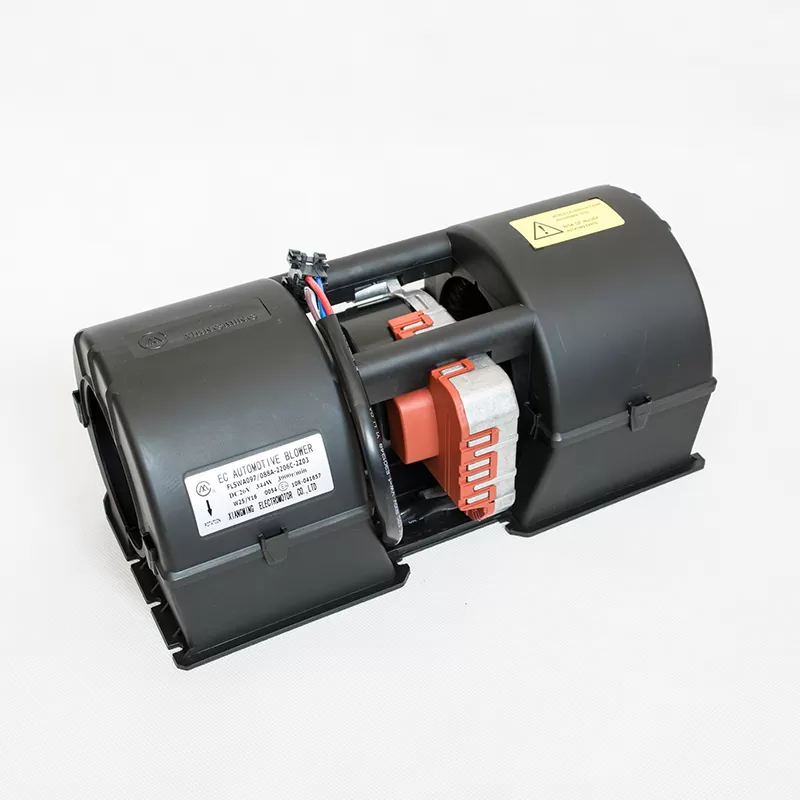
Brushed or brushless? Decide by duty, not by price tag
A brushed blower uses a carbon-brush commutator: simple, cheap, and proven, but the brushes wear and eventually need replacement — acceptable for lighter seasonal use. A brushless (BLDC) blower uses electronic commutation with no mechanical wear point: longer life, steadier output under voltage sag, and better behaviour in dust and heat, at a higher first cost. For tractors that run long shifts, multiple seasons, or in high-dust regions, the brushless option usually earns its price through fewer removals and a wider temperature and voltage window. For seasonal or budget-driven fleets, a quality brushed unit with the correct airflow and a sealed motor is still a sound choice. Specify the motor type deliberately, because it changes maintenance intervals and spare inventory.
Specifying a tractor AC compressor and blower: the RFQ list
A right-first-time order needs more than a model number. Record and pass to the supplier:
- The tractor make, model, and year, plus the existing AC compressor brand and model (this drives clutch fitment).
- Clutch details: pulley diameter, groove type (single/double V), voltage, and coil power — matched to the table above.
- Blower requirements: system voltage, required airflow at the cabin's static pressure (not free air), mounting geometry, rotation, and control interface (PWM specification if brushless).
- The operating envelope: ambient temperature range, dust class, vibration level, and any cabin filtration already fitted.
- The failure history of the unit being replaced, so the supplier can flag chronic weak points.
Ask the supplier to confirm the certificate scope (the product range is produced under TS16949 / ISO9001 quality systems) and the written warranty terms for your application — treat these as confirmation points, not as proof of a specific temperature or life rating.
Installation and upkeep that protect the investment
Even sealed, duty-rated parts depend on the system around them. Keep the cabin filter clean — dust is the fastest route to an overworked blower and an under-cooled cabin. Verify clutch air gap and belt tension at service, confirm blower rotation and any PWM command before commissioning, and check mounts for vibration loosening each season. A compressor that engages smoothly and a blower that moves rated air through a clean coil will outlast any component upgrade made on a neglected system.
FAQs
Can I use a truck or bus compressor clutch on a tractor?
Only after matching it to the tractor's actual AC compressor model. Weili's verified clutches (Thermo King X426/430, Valeo TM65, Bitzer/Bock, Hispacold) cover major compressor platforms, but pulley diameter, groove type, and mounting must match the fitted compressor. Confirm fitment with the supplier before ordering.
Is a brushless blower worth it for agricultural use?
For long-shift, multi-season, or high-dust operation, usually yes: the brushless units offer a wider temperature window (−40 to +85°C), a wide voltage range, and a longer rated life. For light seasonal use, a sealed brushed blower remains cost-effective. The choice should follow duty, not just budget.
What voltage do these components use?
The verified compressors clutches and blowers here are 24 V systems, with blower test voltages spanning 13.5–27 V and the BLDC blower rated for 16–32 V with a 16 V start. Confirm your tractor's system voltage and harness current capacity before specifying.
Do the certifications guarantee performance in my climate?
The components are manufactured under TS16949 / ISO9001 quality systems, and some carry a stated warranty period, but these are quality-system and commercial facts, not specific temperature or lifespan guarantees. Request the current certificate scope and written warranty terms for your application.