
 EN
 ES
 PT
 RU
 AR
 KO
 MY
 FIL
 BE

Reliable Electronic Fans for Construction Machinery: Boosting Engine Cooling Efficiency
Construction machinery lives where engine cooling is hardest: excavators, wheel loaders, dozers, and graders spend their lives at low or zero road speed, buried in dust, vibrating through every joint, and heat-soaked under a hood with no ram air to help. A cooling fan that was adequate on a highway truck can fall short here. Electronic — meaning brushless DC (BLDC) — fans change the equation: they are commanded by the engine's own thermal demand, tolerate a dirty electrical supply, seal against water and grit, and move air against the real resistance of a clogged radiator. This guide is for fleet engineers, OEM specifiers, and parts buyers who need reliable engine cooling on construction sites, not just a part number.
Why construction machinery breaks ordinary fans
On the road, vehicle speed supplies much of the airflow through the radiator. Off-road, there is none. The fan must do all the work, at idle, under full load, and after a machine is parked in sun. Three conditions dominate. First, dust and debris load the radiator core, raising the static pressure the fan must push against. Second, vibration and shock loosen mounts and fatigue windings. Third, the electrical supply is unstable — cranking sag, long harness runs, and alternator ripple. A mechanically driven fan (belt, viscous, or clutch) spins at a fixed ratio to engine speed, so it wastes power at idle and may starve airflow when the engine is loaded but slow. An electronic fan is commanded by temperature, so it delivers airflow when the engine needs it and saves fuel when it does not.
Beyond cooling: fuel, emissions, and idle control
An electronic fan is also an energy decision. A mechanically driven fan draws a fixed parasitic load whenever the engine runs, even when the radiator needs no air — a measurable hit to fuel economy on a machine that already burns heavily. A temperature-commanded BLDC fan draws only what the cooling demand requires, and because it can hold airflow at low engine speed, it reduces the temptation to high-idle a machine just to keep it cool. In regions with anti-idling rules or tight emissions targets, that on-demand control is part of compliance, not a side benefit. For fleets bidding jobs on total cost of ownership, the fan's control strategy belongs in the specification, not the footnote.
What "reliable" means in the spec
For construction duty, the headline number on a datasheet is rarely the number that matters. Confirm these variables before buying:
| Variable | Why it matters off-road | What to look for |
|---|---|---|
| Voltage tolerance | 24V systems sag during crank and under load | A 16–32VDC range with 16V start (Weili BLDC line) |
| Environmental sealing | Pressure washing, fording, fine dust | IP68 motor protection |
| Airflow at static pressure | Free-air volume overstates real performance | m³/h quoted at the radiator's working Pa |
| Control method | ECU needs to modulate speed to demand | PWM speed control |
| Temperature range | Arctic start to heat-soaked bay | −40°C to +120°C on the heavy units |
| Rated life | Duty cycles are harsh and long | ≥25,000–40,000 hours |
| Housing material | Chemical, UV, and impact resistance | PA66 plastic |
A verified heavy-duty BLDC fan line
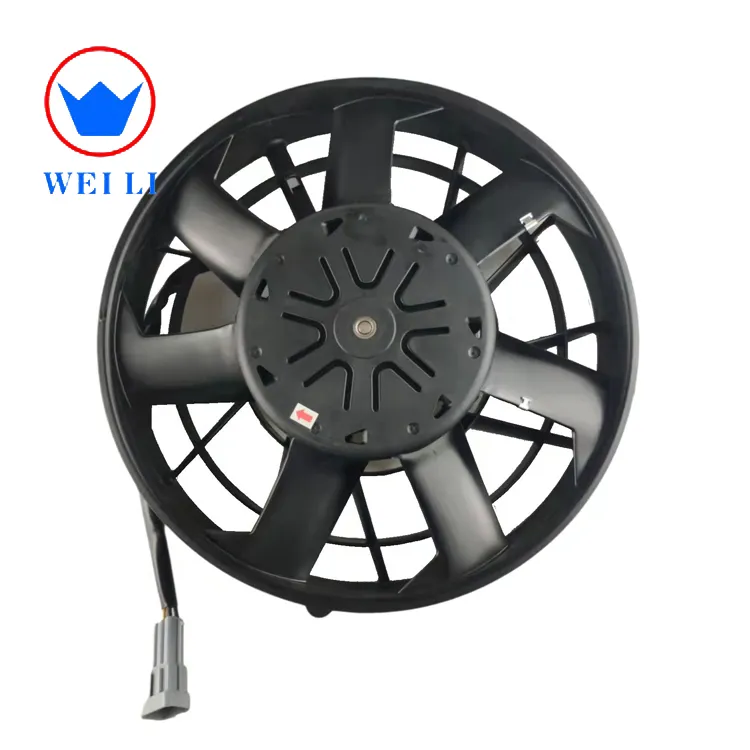
Weili's brushless axial-cooling fans were developed for heavy trucks, new-energy heavy vehicles, and motor or battery cooling — duty profiles that overlap closely with construction machinery: 24V supply with a wide 16–32V tolerance, IP68 sealing, PWM control, PA66 housings on several models, and long rated life. The table below lists verified specifications from the product pages. Because these models are specified for on-road and electric-heavy-vehicle cooling, confirm the exact application fit (mounting, airflow at your radiator's static pressure, control interface) with the supplier before specifying for a specific machine.
| Model | Power | Speed | Airflow (0 Pa / 100 Pa) | Life | Temp range |
|---|---|---|---|---|---|
| WLNF343 | 340W | ≥3400 rpm | 2950 m³/h / — | ≥25,000 h | −20 to +120°C |
| 500W heavy-truck axial | 500W | 4100 rpm | 3700 m³/h / — | ≥25,000 h | −40 to +120°C |
| New-energy heavy axial | 500W | 4100 rpm | 3700 m³/h / — | ≥25,000 h | −40 to +120°C |
| WLNF335P (motor cooling) | 370W | 4450 rpm | 2550 / 2400 m³/h | ≥40,000 h | −40 to +95°C |
| WLNF255-12WK | 260W | 3750 rpm | 1800 / 1600 m³/h | ≥40,000 h | −40 to +95°C |
| 100W BLDC condenser | 100W | 3750 rpm | 650 / 600 m³/h | ≥40,000 h | −40 to +95°C |
Where a 100 Pa figure is not published, ask the supplier for the static-pressure curve — the airflow that cools your engine is the figure at the radiator's working resistance, not at zero pressure. For the brushed-versus-brushless trade-off behind these designs, see our guide on brushed and brushless fans.
Sizing the fan to the radiator
A fan is only as good as its match to the heat exchanger. Start from the engine's heat-rejection duty at worst-case ambient and load, then size the fan to deliver the required airflow at the radiator's working static pressure — not the catalogue free-air number. Cover the full active core: a fan smaller than the radiator face, or one mounted without a shroud, simply bypasses air around the fins. Diameter, blade count, and motor power set the envelope, but the decisive test is airflow through the installed core under the dirtiest credible condition. Where Weili publishes a 100 Pa figure — for example 600, 1600, or 2400 m³/h on several models — use that as the realistic baseline and ask for the full curve on the others.
Specifying an electronic fan for your machine
A right-first-time order needs more than a model number. Record the machine and engine model, the radiator's physical size and fin density, the available system voltage and harness current capacity, the required airflow at the radiator's static pressure (not free air), the mounting geometry (shroud, ring, or bolt pattern), rotation and push-pull direction, and the control interface (PWM signal specification). State the ambient and dust class and the sealing requirement. As a rule of thumb, also give the supplier the radiator's face area in millimetres, the current fan's part number if known, and the highest ambient the machine sees — a machine working 45°C deserts and one in a 5°C quarry are different specifications. Hand all of this to the supplier alongside the failure history of the unit you are replacing.
Installation and upkeep that protect the investment
A sealed fan still depends on the system around it. Keep the radiator core clean — dust is the number-one cause of overheating on site, and it raises the very static pressure the fan must beat. Confirm the shroud so air passes through the core, not around it, and verify rotation direction and the PWM command before commissioning. Periodically reverse-clean the core and check mounts for vibration loosening. For machines that cannot afford a cooling outage mid-shift, consider a redundant or duty/standby fan arrangement and keep a matched spare on the shelf, because the cost of a stopped excavator dwarfs the price of the part. As our guide on the role of condenser fans notes, a fan that spins can still be the wrong fan if it does not move the required air through the installed core.
FAQ
Can an electronic fan replace a belt-driven viscous fan on my excavator?
Often, as a retrofit or OEM option, but it is a system change: you need ECU or PWM control, a 24V supply with the right current capacity, correct mounting, and airflow validated at the radiator's static pressure. Confirm the approach with the machine and fan supplier.
Why does IP68 matter if the fan sits inside the engine bay?
Construction machines get pressure-washed, ford water, and run in mud. IP68 protects the motor from ingestion that would kill a vented unit, and it also resists the fine dust that bypasses lesser seals.
Free-air volume looks huge — why do I care about 100 Pa?
Free air is measured with no resistance. A dust-loaded or fin-dense radiator can present 100 Pa or more. The airflow that counts is what the fan delivers at that pressure, which is far lower than the headline number.
Are these fans rated for construction machinery specifically?
The verified Weili models are specified for heavy trucks, new-energy heavy vehicles, and motor or battery cooling. Their duty profile — 24V with wide tolerance, IP68, high static-pressure airflow, long life — matches construction demands, but confirm the exact application fit (mounting, airflow at your radiator's Pa, control interface) with the supplier before specifying.
What should I send a supplier for a fast, correct quote?
Machine and engine model, radiator dimensions, system voltage, required airflow at static pressure, mounting geometry, rotation, and control signal. The checklist above covers it.