
 EN
 ES
 PT
 RU
 AR
 KO
 MY
 FIL
 BE

To evaluate a commercial vehicle AC fan for road vibration, match the evidence to its mounting location and complete installed assembly. Check the bracket, fasteners, rotating clearances and cable support, then request a test report with defined exposure and functional acceptance criteria. At Weili, our bus AC condenser fan range provides candidates for this review. Electrical and airflow specifications establish a starting point; approval for a particular road environment requires evidence that covers the selected model and installation.
Define where the fan will operate
Record whether the fan sits in a rooftop AC module, a body-mounted condenser assembly or another vehicle location. Include the supporting structure, installation orientation and expected route conditions. ISO 16750-3:2023 addresses mechanical loads for vehicle electrical and electronic equipment, with tests and requirements linked to mounting location. Use the applicable standard and vehicle specification to agree a test plan; a reference to the standard alone does not establish a fan's qualification.
Separate road input from vibration generated by operating equipment. AMC Mecanocaucho's public transport HVAC guidance explains that AC equipment both generates vibration through components such as fans and motors and receives dynamic loads from vehicle operation. For a Weili condenser fan candidate, define the operating speeds and mounting arrangement together. A stationary running check cannot establish how that assembly will behave under road excitation.

Review the installation before comparing durability claims
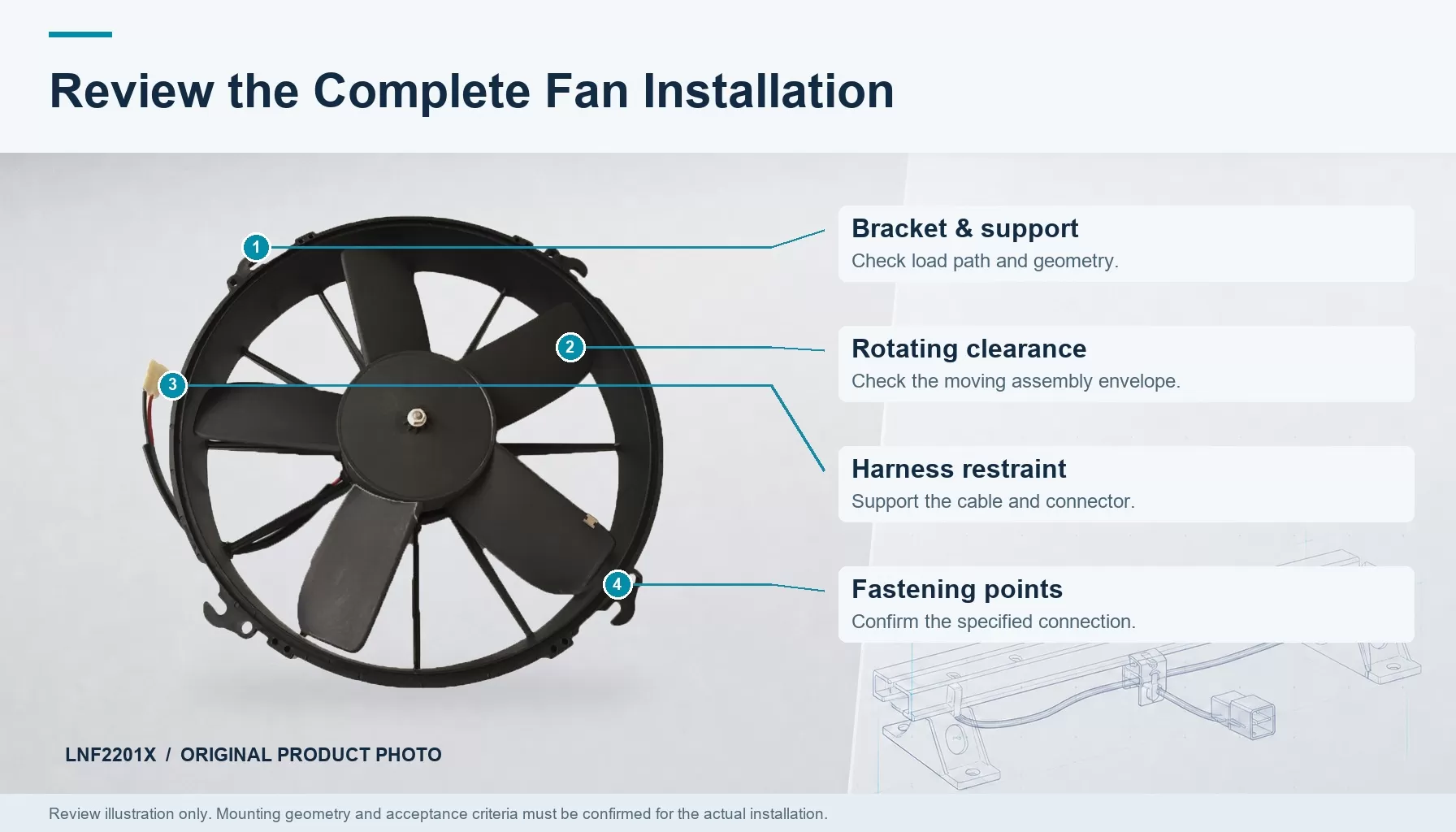
Begin with the drawing for the exact fan version. Check the mounting points, bracket support and clearance around the rotating assembly, then review the cable exit and connector restraint. For example, our LNF2201X suction axial condenser fan is a candidate for a bus AC installation review. Its product identity does not authorize reusing an old bracket without checking the mounting geometry and instructions.
Ask how the proposed mount controls movement as well as vibration transmission. An isolator can reduce transmission, but its selection must account for equipment weight, excitation and available space. Allowing more movement can conflict with blade, housing or harness clearance. Have the responsible engineer evaluate the mount with the fan and supporting module; adding a softer rubber part is not a substitute for that review.
Match the vibration report to the ordered assembly
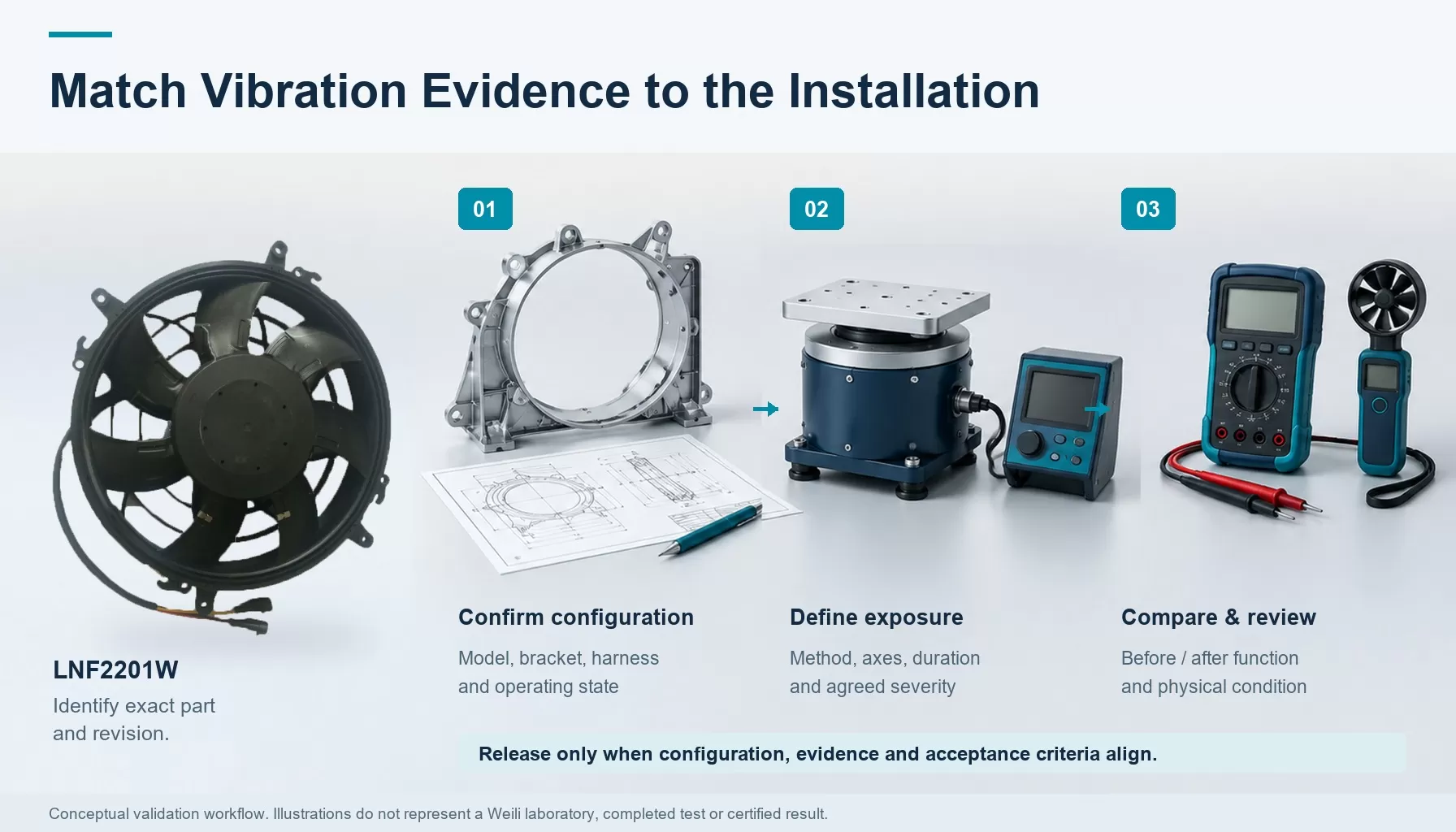
For a proposed LNF2201X or LNF2201W installation, request the available model-specific report and reconcile it with the production drawing. If the evidence covers a related model, ask which differences were assessed and why the result applies. Keep an unexplained configuration difference open until the supplier and vehicle engineer resolve it.
| Review item | Evidence to request | Decision consequence |
|---|---|---|
| Tested hardware | Part number, revision, motor and control version | Confirm that the result covers the ordered assembly. |
| Mounting arrangement | Fixture, bracket, orientation and fastening details | Identify differences from the vehicle installation. |
| Exposure | Method, frequency range, severity, axes and duration | Compare the exposure with the agreed vehicle requirement. |
| Operating state | Supply voltage, fan speed states and monitoring method | Determine which operating conditions the evidence covers. |
| Acceptance | Inspection criteria and functional results before and after exposure | Check continued function as well as visible condition. |
Read the full exposure definition rather than comparing a single acceleration value. A number without its frequency content, duration and mounting context leaves the comparison incomplete. Agree the required profile and acceptance limits before commissioning further testing. Do not derive a vibration rating from a fan's airflow value, brushless designation or an unrelated environmental claim.
Verify function under comparable conditions
For our LNF2201W brushless condenser fan, the published specification combines a 26 V test supply, current of no more than 13.5 A and airflow of at least 2500 m3/h at 100 Pa. Keep these reference conditions together when preparing a functional comparison, and request separate vibration evidence for the intended mounting configuration.
For the selected fan, record a functional baseline and repeat the agreed checks after exposure using comparable supply and airflow resistance. Define acceptable changes in current and airflow in advance. Include checks for intermittent operation during the test where required, then inspect mounting points, rotating clearance and cable restraint afterward. Escalate rubbing, loose connections or an unexplained performance change before approving the assembly.
Keep the approved configuration under change control. If a replacement bracket, motor revision or mounting change falls outside the assessed configuration, ask whether further review or testing is needed. Retaining the same voltage and nominal fan size does not resolve those differences.
Prepare a specific technical inquiry
When contacting Weili about a condenser fan candidate, provide the model or existing part number, mounting drawing, vehicle location, supply and control requirements, and required vibration profile. Ask for the current mounting instructions and any applicable test evidence. If the available evidence does not cover the proposed installation, agree who will validate it and what constitutes acceptance before placing a production order.
FAQ
Which Weili condenser fan should enter the initial review
The LNF2201X suction axial fan and LNF2201W brushless fan are two published options in our condenser fan range. Shortlist by airflow duty, electrical version and mounting fit. For each shortlisted version, reconcile the available vibration evidence with the proposed vehicle assembly before approval.
Does the LNF2201W brushless design prove vibration resistance
No. The brushless designation identifies the motor type; a vibration decision still needs evidence for the assembled fan, its mount and the required exposure. For an LNF2201W inquiry, request the applicable report and confirm the tested hardware revision and operating state.
Can an LNF2201X replacement use the existing bracket and wiring
Confirm both before reuse. The LNF2201X specification includes 27 V and 13.5 V test entries, so identify the ordered voltage version rather than assuming one unit suits both systems. Send bracket dimensions, mounting orientation and connector details for confirmation, including whether the available vibration evidence covers that arrangement.
What if the required vibration report is unavailable
Keep qualification open for the proposed Weili model. Request the evidence that is available, document the gaps against the vehicle requirement and agree a validation plan with the responsible engineer. A sample can support evaluation, but receiving one does not by itself establish endurance or authorize production approval.