
 EN
 ES
 PT
 RU
 AR
 KO
 MY
 FIL
 BE

Optimize Your Climate: Energy-Saving Fans for Long-Haul Comfort
Energy-saving comfort on a long haul is not about a single magic fan. It is about matching the climate-system fans to the haul's duty cycle so the condenser fan and the cabin blower draw only the power each moment needs. A brushless (BLDC) fan with PWM control runs at the speed the load demands instead of jumping between fixed resistor steps, which is where most wasted climate energy goes. This guide shows where fan energy is spent across a driving day, why variable-speed BLDC fans reduce that spend, and how to specify them so drivers stay comfortable while the alternator load and battery drain stay under control.
Why the long-hul duty cycle exposes fan energy waste
A day cab on a short urban route cools for an hour and stops. A long-haul tractor runs its climate hardware for the whole duty cycle: highway driving, queue and dock idling, and the sleeper period when the engine may be off and the cab still needs air. During that off-engine window the climate fans draw straight from the battery, so every wasted watt shortens rest time before the alternator has to run again.
The waste is structural, not accidental. A fixed-speed fan or a brushed blower with a resistor pack is either on at a preset step or off. Most of a haul, the thermal load is partial: mild morning, steady cruise, light passenger load. At partial load a stepped fan still pulls close to its full current because the excess energy is burned in the resistor rather than turned into airflow. A variable-speed BLDC fan removes that resistor loss by trimming speed to the actual need.
The two fans that decide your climate energy bill
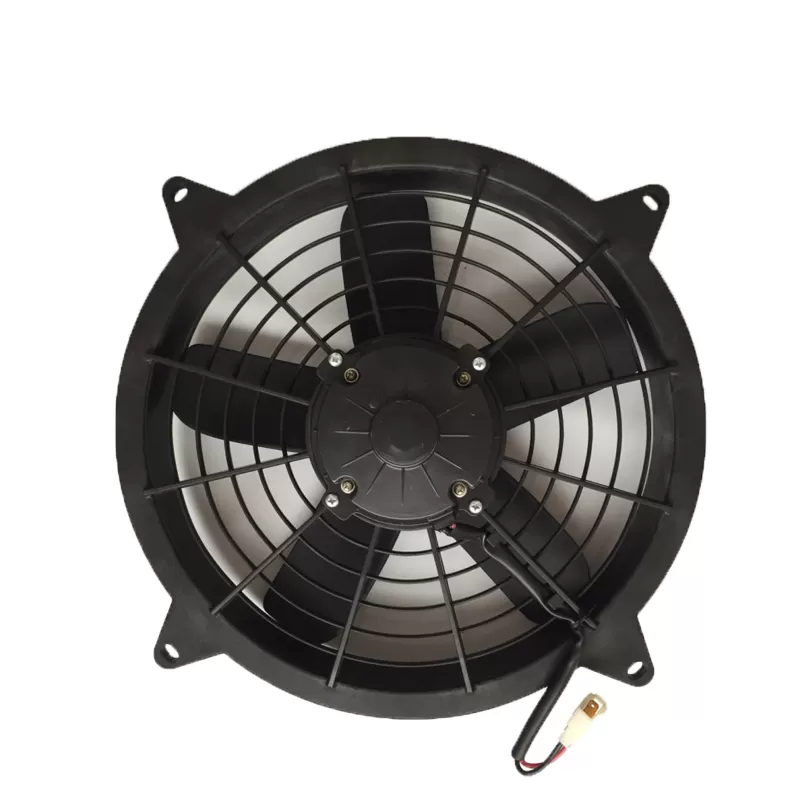
Two fans carry almost all of the climate electrical load. The condenser fan sits on the high-pressure side and pushes air through the condenser so the compressor can reject heat; it is a large, continuous draw whenever the system runs. The cabin blower (evaporator motor) moves conditioned air into the sleeper and cockpit; it runs for the whole comfort period, including off-engine rest. Trimming either one pays back across the duty cycle, and the role of the condenser fan explains why its draw matters as much as the blower's.
| Duty phase | What is drawing power | Fixed-speed / resistor behaviour | BLDC + PWM behaviour |
|---|---|---|---|
| Driving (steady cruise) | Condenser fan and blower from the alternator | Runs at preset steps; resistor burns the difference at partial thermal load | Trims both fans to the load, lowering alternator load and fuel burn for the miles that matter |
| Idling at dock or queue | Condenser fan and blower from a low-output engine | Full-step draw stresses an already low charging margin | Part-load speed keeps comfort while easing the load on a weak idle charge |
| Off-engine sleeper climate | Blower (and any aux condenser fan) from the battery | Fixed high draw drains the battery fast, cutting rest time | Low part-load draw extends battery rest before the engine must restart |
| Heat-soak recovery after parking | Both fans at peak | Abrupt full-on surge, then no finer control as the cab cools | Ramps down as the load falls, avoiding a sustained full-power hold |
What actually makes a fan energy-saving
Energy saving is designed into the motor and drive, not printed on the box. The properties below are the ones that change the duty-cycle draw, and each is shown against verified Weili fan specifications.
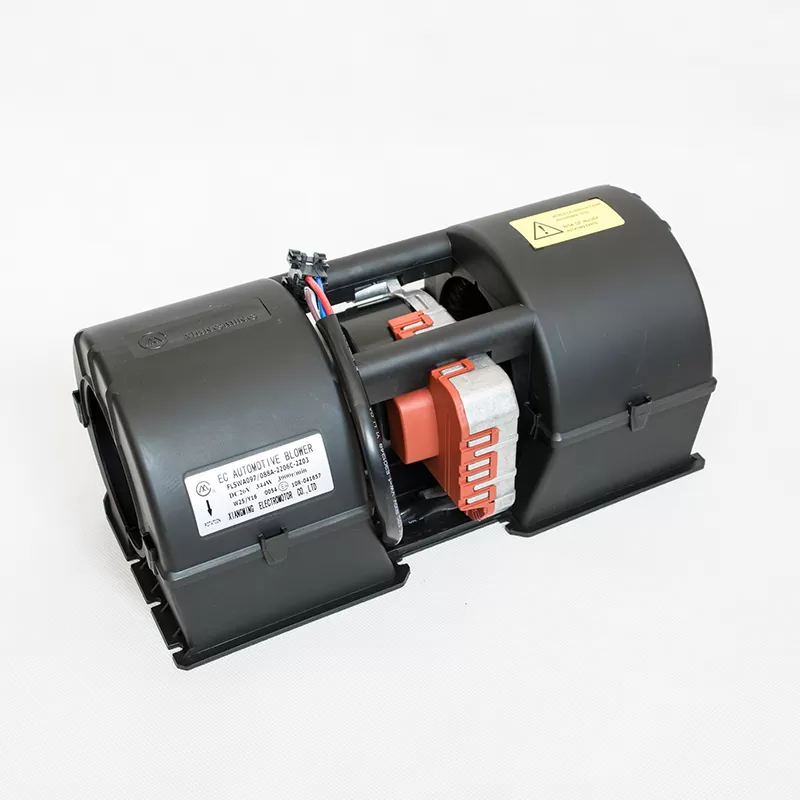
Brushless commutation with PWM control. Removing the brushes and driving the motor electronically lets it run at any speed the controller asks for, so it is never forced to dump energy in a resistor. Weili lists PWM-controlled BLDC units such as the 24V 340W axial condenser fan (WLNF343, 2950 m³/h, IP68, −20°C to +120°C, rated life ≥25000 hours) and the 24V 160W-class BLDC centrifugal blower (600 m³/h at 100 Pa, 16 to 32V, 16V start, −40°C to +85°C, ≥25000 hours).
Low part-load current. A variable-speed fan's advantage shows up at the speeds it runs most. The axial condenser fan LNF2781X is rated at ≥1800 m³/h at 100 Pa with current of ≤8A at 27V and ≤16A at 13.5V, giving the supplier a concrete draw to compare against a fixed-speed replacement. The brushless cabin blower ZHF2101ZW is rated 24V with ≥1000 m³/h at 100 Pa for the sleeper-side delivery.
Wide voltage tolerance. Long-haul electrical systems sag at idle and during cranking. A fan rated across a wide range, such as 16 to 32V with a 16V start, keeps running efficiently through those dips instead of stalling or pulling a recovery surge. The brushed versus brushless comparison covers why the brushless path is the one that sustains efficiency over life.
Specify an energy-saving fan for your haul
The free-air number on a datasheet does not tell you the duty-cycle cost. Against the condenser coil or the cabin duct, what counts is airflow at static pressure plus the electrical behaviour across your real voltage range. Hand the supplier the items below so the recommendation is built for your haul, not a catalogue.
| Parameter | Why it decides the energy use | What to give the supplier |
|---|---|---|
| Airflow at static pressure (m³/h at ___ Pa) | Duct and coil resistance drop free-air figures; the real draw is spent moving air that the system actually uses | The pressure your condenser coil or cabin duct presents |
| Rated power and part-load current | Full-load watts matter, but part-load current decides most of the haul's cost | Ask for the draw at typical duty speed, rather than peak only |
| Voltage range and start voltage | Survives idle and crank dips without a recovery surge | Nominal 24V, worst-case dip, and crank behaviour |
| Control interface (PWM or signal) | Proportional speed needs a matching controller or built-in drive | The cab or condenser control module's speed-input type |
| Mounting, size, and airflow direction | Must seat in the existing housing and push the right way | Dimensions, housing type, flow direction, and a photo |
| Temperature range and duty life | Must survive heat soak, vibration, and long routes without efficiency fade | Climate and route profile |
Quality paperwork stays a confirmation point, not a sales claim. Request the current certificate scope, issuing body, and written warranty terms for the exact part number, and confirm the product listing covers long-haul truck applications before you specify. Weili product pages list applications across trucks, buses, heavy trucks, new-energy vehicles, and transport refrigeration; match the unit to your specific tractor and sleeper configuration rather than assuming coverage. The evaporator blower guide shows why the cabin-side motor is the delivery link for comfort, and the AC blower selection guide walks through the matching steps.
FAQs
Do energy-saving fans actually reduce fuel use on a long haul?
They reduce the electrical load the engine must offset through the alternator, which is the realistic, verifiable effect. A variable-speed BLDC fan avoids the resistor losses a fixed-speed unit burns at partial load, so less engine power goes to the climate system during the cruise miles. The exact fuel change depends on your route and duty profile, so ask the supplier for the part-load current rather than a generic saving figure.
Which fan saves more energy, the condenser fan or the blower?
It depends on how you run. The condenser fan is the larger continuous draw whenever the compressor runs, so on hot, high-load routes it dominates. The blower runs through the whole comfort period including off-engine rest, so on sleeper-heavy hauls its part-load draw matters most. Trimming both with BLDC and PWM covers both cases; the condenser fan role explains the high-side draw in detail.
Can an energy-saving fan run my sleeper climate longer on battery?
Yes, when it is a variable-speed BLDC blower sized to the duct's static pressure. At partial night load it draws far less than a fixed high step, extending battery rest before the engine must restart. Confirm the part-load current and the cabin airflow at 100 Pa with the supplier, and check that your battery and harness can carry the continuous draw safely.
Are brushless fans worth the cost over brushed for energy saving?
For long-haul duty where the fans run for the whole cycle, yes. Brushless units remove the resistor-pack loss and the brush wear point, so efficiency holds over life instead of fading. Brushed units remain usable for lighter or intermittent roles, but they step between speeds rather than trimming to the load. Confirm the control interface and mounting with the supplier before ordering.
What should I send the supplier to start an energy review?
Your tractor make and model, the current condenser-fan and blower part numbers, the cab or condenser control module's speed-input type, the nominal voltage and worst-case dip, and your climate and route profile. With those, the supplier can compare airflow at static pressure, part-load current, voltage behaviour, and application fit against the verified BLDC fan range rather than guessing from a free-air number.