
 EN
 ES
 PT
 RU
 AR
 KO
 MY
 FIL
 BE

Premium Replacement Parts for Bus and Coach Air Conditioning Systems
What "premium" means for a bus air-conditioning part
On a bus or coach, an air-conditioning failure is not a comfort nuisance — it is a passenger-complaint, a driver-fatigue, and in winter a visibility event. A premium replacement part is therefore not the most expensive line on the quote; it is the part whose specification, build, and traceability actually match the bus duty cycle: long continuous running, high cabin heat load from glazing and passenger density, frequent door cycles, and the safety-critical defrost path. This guide is written for bus and coach fleet engineers, depot workshops, and distributors who specify replacement AC components, and it walks through the components that matter most, with verified specifications you can check against your own units. "Premium" here means fitment-accurate, duty-rated, and supplied with evidence — not a marketing label.
The four components that decide bus AC reliability
A bus roof- or engine-mounted AC system shares the same vapor-compression loop as any vehicle, but the duty is harder. The parts that most often decide uptime are:
- Compressor clutch — engages the belt-driven compressor thousands of times per season; the pulley bearing and friction face are the usual first failure on bus units.
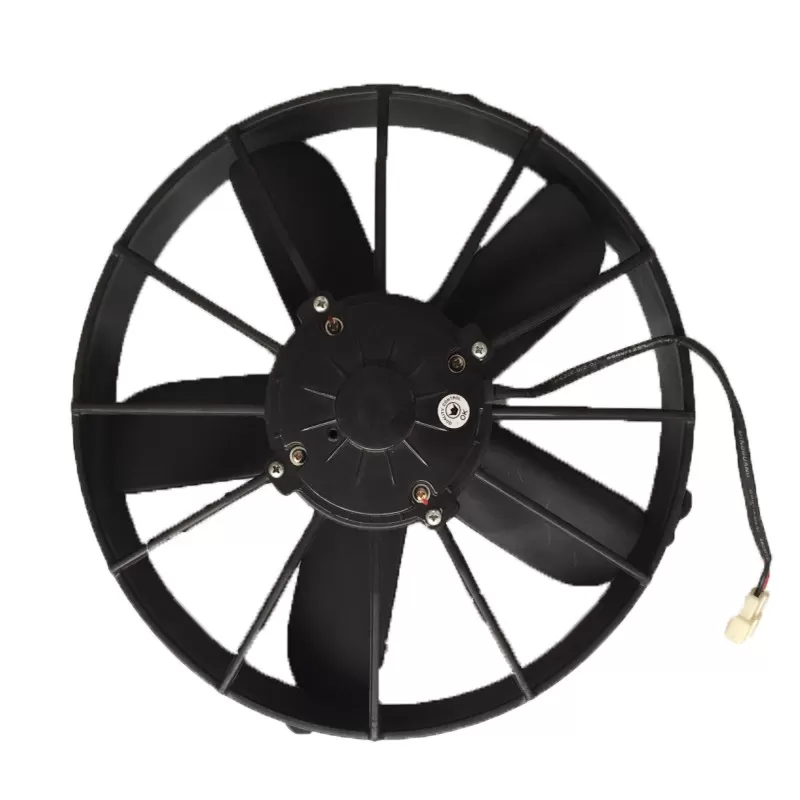
- Condenser fan — rejects heat at the roof or rear; it must hold airflow at idle and in traffic, where buses spend much of their life.
- Evaporator blower — pushes conditioned air into a long cabin; airflow and balance decide whether every row is comfortable.
- Defroster / windshield heater — a safety component that clears the windshield; its failure directly affects driver visibility.
Our earlier piece on why the evaporator blower motor is essential covers the blower's role in detail; the point here is to treat all four as a coordinated replacement programme rather than isolated purchases.
The link between duty and specification is worth making explicit, because it is where "premium" stops being a slogan and becomes a checklist. A city bus idling in a boarding queue loads the condenser fan at zero road speed and high ambient — so a high static-pressure airflow rating (not a free-air number) is the premium criterion there. A long-distance coach running eight hours straight loads the evaporator blower continuously and the clutch through thousands of engagement cycles — so motor life, thermal rating, and balanced airflow down a long duct are the premium criteria. A winter-route operator lives or dies by the defroster's ability to clear the windshield before the first pickup. The same four components, four different weighting rules — all decided by the route, not by the catalogue.
Compressor clutches: match the bus compressor exactly
For belt-driven bus AC compressors, the verified clutch platforms below are the fitment checklist. Pulley diameter, groove type, voltage, and coil power must match the compressor already fitted — a wrong pulley means a return, not a comeback:
| Clutch platform | Voltage | Pulley diameter | Groove | Bus application |
|---|---|---|---|---|
| Thermo King X426 / X430 | 24 V | φ210 mm | 2B | Bus / transport AC compressors |
| Valeo TM65 | 24 V / 60 W | φ260 / φ210 mm | 2A–2B | Heavy-duty AC compressors |
| Bitzer / Bock | 24 V | φ200 mm | 2B | Bus / refrigeration compressors |
| Hispacold | 24 V | φ210 mm | 2B | Bus / coach AC compressors |
Confirm the clutch against the actual compressor model on the vehicle. These are product specifications, not a guarantee of direct fit to a particular bus.
Condenser fans: hold airflow where buses live — at idle
A bus condenser fan must perform at zero road speed, in a stationary queue, on a hot roof. Weili's verified bus condenser fans include brushless (BLDC) units built for exactly that duty. The 24 V brushless model LNF2201W, for example, is rated at ≥2500 m³/h at 100 Pa and ≤13.5 A at a 26 V test voltage — a high static-pressure airflow that matters more than free-air numbers when the coil is clogged with road film. Brushless construction also removes the brush wear point, which suits the long, continuous running a bus demands.
Evaporator blowers: size the cabin, not the catalogue
Bus cabins are long and densely loaded, so evaporator blower choice is about delivering rated air through the duct at static pressure, not a headline figure. Weili's verified bus evaporator blower range spans brushed and brushless centrifugal units in several diameters:
| Model | Type | Voltage | Airflow @100 Pa | Speed | Note |
|---|---|---|---|---|---|
| ZHF2827A | Brushed double | 24 V (test 27 V) | ≥1100 m³/h | 4100±200 rpm | 345 mm, with resistor |
| ZHF2101Z | Brushed twin | 24 V (test 27 / 13.5 V) | ≥1000 m³/h | 3900±200 rpm | 351 mm twin blower |
| ZHF2101ZW | Brushless | 24 V (test 26 V) | ≥1000 m³/h | — | High-airflow, ≤12.5 A |
| ZHF2602DZ | Brushed | 24 V (test 27 / 13.5 V) | ≥800 m³/h | 3700±200 rpm | Engineering-vehicle blower |
For the longer, higher-heat-duty coaches, a brushless blower (such as ZHF2101ZW) extends service life and tolerates a wider voltage window; for standard city buses, a sized brushed unit with the correct resistor and airflow point remains cost-effective. Specify the airflow at the cabin's static pressure, the mounting geometry, and the rotation — not just the diameter.
Defrosters: the safety part operators forget
The windshield defroster is the component that turns a working heater into clear visibility. Weili's verified CS2725 bus/coach windshield heater defroster is rated at 180 W with an exhaust (air delivery) of ≥700 m³/h at a 27 / 13.5 V test voltage. On cold or humid routes, a failed defroster is a road-safety issue, so it belongs in the same premium-replacement programme as the compressor and blowers — not in the "cheapest available" bin.
Why bus AC parts wear differently from truck parts
The same component fails differently on a bus. Roof-mounted units sit in direct sun and heat soak, raising motor winding temperature and accelerating insulation and bearing wear. Road vibration is constant rather than occasional, loosening mounts and fatiguing harnesses. Frequent door cycles inject humidity and dust into the cabin and filter, raising the static pressure the blower must overcome. And because buses idle in queues, the 24 V supply sags and ripples more than on a moving vehicle. A premium bus part is therefore one validated against exactly these conditions — wider voltage tolerance, higher thermal rating, balanced and sealed construction — not a part that merely fits a truck and is hoped to survive on a roof.
How to buy bus AC parts as a programme, not a panic
Premium outcomes come from process. Group your fleet by roof/engine AC unit and compressor model, validate one clutch, one condenser-fan family, and one or two blower types per cabin class, and keep the defroster on the same approved list. Before committing, ask the supplier for the certificate scope (the range is produced under TS16949 / ISO9001 quality systems), traceability and change-control terms, the written warranty for your application, and a sample for bench and field testing. Treat the quality-system references and any stated warranty period as confirmation points — request the current certificate scope and written terms rather than assuming a specific temperature or life rating.
Frequently asked questions
Are brushless bus fans worth the higher cost?
For buses that run long shifts or in high-heat climates, usually yes: brushless units remove the brush wear point, hold airflow better under voltage sag, and suit continuous duty. For lighter or seasonal duty, a sized brushed fan is often the better value. Decide by route, not by price alone.
Can I mix blower diameters across my fleet?
Only where the cabin and duct are genuinely the same. Different diameters imply different airflow and mounting; keep one validated blower per cabin class to avoid mis-picks and simplify warranty.
Do the certifications guarantee winter or summer performance?
The components are manufactured under TS16949 / ISO9001 systems and some carry a stated warranty, but these are quality-system and commercial facts, not specific climate guarantees. Request the current certificate scope and written warranty terms for your duty.
Should the defroster be part of the AC replacement programme?
Yes. It shares the same supply, mounting, and visibility-safety role, so including it on the approved list prevents a small, forgotten part from becoming a driver-visibility failure in winter.