
 EN
 ES
 PT
 RU
 AR
 KO
 MY
 FIL
 BE

Understanding the Role of Electronic Fans in Modern Truck HVAC Systems
Modern truck cab air conditioning is no longer a belt-driven compressor with a passive fan bolted behind the condenser. On city-delivery trucks that idle for hours, on electric and hybrid tractors with no engine belt to turn, and on long-haul sleeper cabs where cabin temperature is a driver-retention and safety issue, the electronic fan has become one of the most decisive components in the HVAC loop. This article explains what "electronic fan" actually means in a truck HVAC system, the two distinct jobs it does, why modern trucks depend on it more than older ones did, and what to verify before you specify a replacement. The goal is to make the role concrete rather than treat "electronic fan" as a vague upgrade label.
What an electronic fan is in truck HVAC
In this context, "electronic fan" does not mean one part. It refers to the fans in the HVAC system that are electrically driven and electronically controlled, as opposed to mechanically driven by the engine through a belt, viscous coupling, or clutch. Two components fit that description:
- The condenser fan — mounted at the high side of the refrigeration loop. It pulls or pushes ambient air through the condenser coil so the refrigerant can reject heat and condense. In modern trucks it is increasingly a brushless DC (BLDC) axial fan with PWM speed control.
- The evaporator blower — the cabin-side fan that moves conditioned air from the evaporator through the ducting to the driver and passengers. Even where it has long been electric, it is now shifting from a brushed motor with a resistor to electronically commutated, variable-speed designs.
Our guide on the role of condenser fans covers the high-side fan in detail; the point here is wider — to show how both fans, working under electronic control, shape the whole system's behaviour.
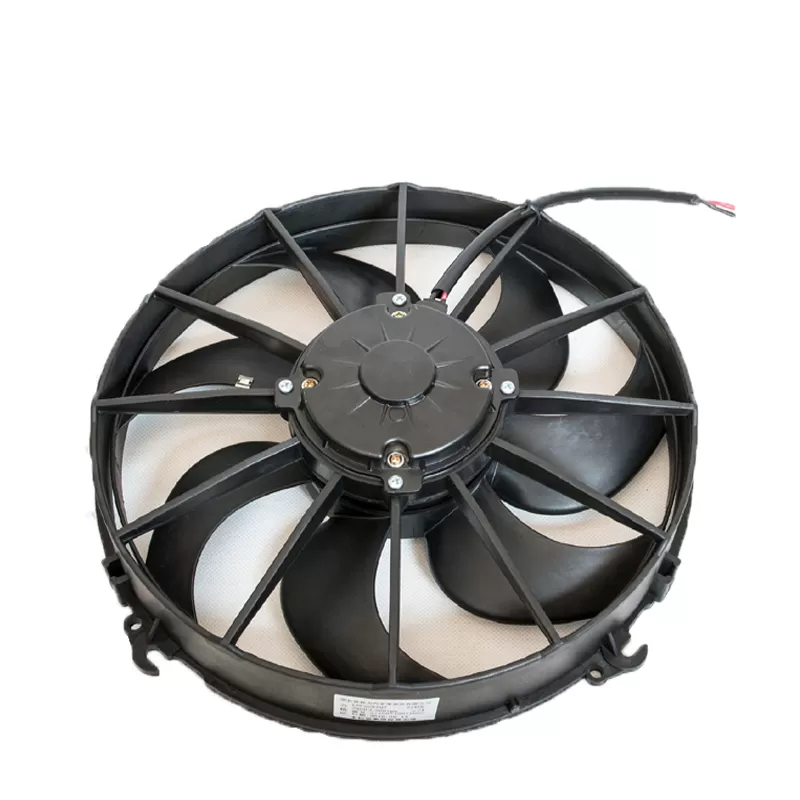
Why modern trucks lean on electronic fans
Older trucks could rely on road speed and a mechanically driven fan for most cooling. Several shifts have made electronic fans central:
- Idle and low-speed duty. Delivery routes, dock queues, and PTO operation mean the truck often sits with little road airflow. A mechanically driven fan at idle may not deliver enough air, while an electronic fan is commanded by temperature and runs hard exactly when it is needed.
- Electric and hybrid powertrains. With no belt from a running engine, the condenser fan must be electric. This is now standard on new-energy heavy trucks and expanding across the segment.
- Cabin comfort and regulation. Sleeper-cab rest mandates, driver-retention expectations, and warm-climate standards make steady, controllable cabin airflow a requirement, not a luxury.
- Fuel, emissions, and noise. An electronic fan draws only the power the cooling demand requires, and it can be quiet at partial load — useful near residential delivery zones.
- Diagnostics. Electronically controlled fans report speed and faults, feeding telematics that flag a failing unit before it strands a load.
The two jobs electronic fans do in the loop
Each fan protects a different part of the system. Confusing them leads to the wrong replacement.
| Role | What fails if it is weak | Verified Weili examples (specified applications) |
|---|---|---|
| Condenser fan (high side) | High-side pressure climbs, compressor labour rises, cooling drops in traffic and at idle; the cabin warms precisely when the truck is stuck in heat. | Bus/truck AC radiator condenser fan LNF2781X: test 27V/13.5V, current ≤8A/16A, 2800±200 rpm, static pressure 100 Pa, air volume ≥1800 m³/h. Heavy-truck BLDC axial WLNF343: 24V, 340W, ≥3400 rpm, ≤14A, 2950 m³/h, IP68, −20→+120°C, ≥25000 h, PWM. |
| Evaporator blower (cabin side) | Weak or uneven cabin airflow, slow defrost, driver fatigue; the compressor may be fine yet the cab still feels wrong. | Bus-coach windshield defroster CS2725: 180W, air volume ≥700 m³/h (a safety-linked cabin fan). BLDC centrifugal blowers in the 100–160W class with ≥25000 h life and −40→+85°C rating support steady cabin air on long routes. |
The takeaway: a truck HVAC system can have a healthy compressor and still fail the driver because one electronically controlled fan is not doing its job. That is why "does the fan run" is the wrong question — the right one is whether the installed fan moves the required air through its heat exchanger or duct at the vehicle's worst credible condition.
The two fans should also be specified as a pair, not separately. A condenser fan that keeps the high side healthy does little if the evaporator blower cannot deliver that cooling into the cabin; conversely, a powerful blower cannot compensate for a condenser fan that lets head pressure run high in traffic. On modern trucks where both are electronically controlled, the better designs coordinate them — ramping the condenser fan with compressor load and the blower with cabin setpoint — so the system behaves as one unit rather than two independent parts. When you replace one, check whether the other is still matched to the same duty.
Brushed or brushless — the electronic-era choice
As our brushed vs brushless fans explainer notes, brushed motors use a carbon brush and commutator that wear; brushless motors use electronic commutation with no mechanical wear point. In truck HVAC, brushless (BLDC) wins on life and controllability for high-duty condenser and blower roles, while a quality brushed unit remains a reasonable choice for lighter duty or budget-driven fleets. The decision should follow duty cycle, not fashion.
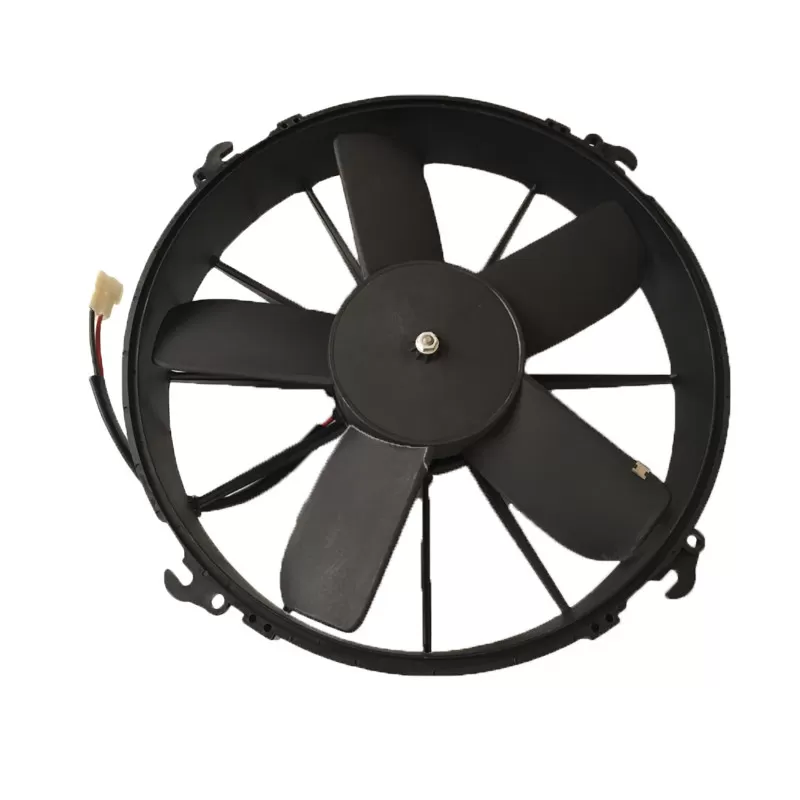
What "electronic" actually buys you
| Capability | Why it matters in a truck |
|---|---|
| PWM / proportional speed | Matches airflow to demand instead of full-on or off, trimming power draw and noise. |
| Sensorless BLDC commutation | No brushes to wear; long life under vibration and heat. |
| Wide voltage tolerance (≈16–32V) | Survives the voltage dips and spikes common at idle and during cranking. |
| Sealing (e.g. IP68) | Resists the wash-down, dust, and moisture a truck sees daily. |
| Low partial-load power | Cuts the alternator load that would otherwise burn fuel. |
| Diagnostics / telemetry | Reports speed and faults so maintenance is planned, not reactive. |
Specifying and the common pitfalls
An electronic fan is only as good as its fit to the installed system. Verify the operating point — airflow at the heat exchanger's static pressure, not free-air volume — the rotation and push-pull direction, the mounting geometry (shroud, ring, or bolt pattern), the control interface (PWM specification), and the voltage and harness current capacity. A fan that spins can still be the wrong fan if air bypasses the core or the blade turns the wrong way. For the condenser side specifically, see the dedicated condenser-fan specification guide.
FAQs
Are electronic fans only for electric trucks?
No. They are used across diesel, hybrid, and electric trucks because they solve idle, low-speed, noise, and control problems that mechanical fans handle poorly. Electric trucks simply make them mandatory.
Can I swap a brushed blower for a brushless one?
Only after confirming the control interface, voltage, mounting, and airflow point match. Brushless units need a compatible controller or built-in drive; a direct plug-in is not guaranteed. Confirm with the supplier against the unit you are replacing.
Does a higher free-air volume number mean better cooling?
Not by itself. What matters is airflow against the installed heat-exchanger static pressure. A fan with a big free-air number can still underperform once the condenser or filter adds resistance.
How do I know an electronic fan is failing before it strands a load?
Watch for rising high-side pressure at idle, uneven cabin airflow, unusual noise, and any fault code from the fan controller. Scheduled inspection of mounts, harness, and core cleanliness catches most issues early.