
 EN
 ES
 PT
 RU
 AR
 KO
 MY
 FIL
 BE

Turbocharged Airflow: The Ultimate Upgrade for Truck HVAC Systems
Upgrading truck HVAC airflow means replacing the system's air-moving components, the condenser fan on the high side and the evaporator blower on the cabin side, instead of the compressor. Most cabin-cooling complaints in otherwise working trucks trace to weak or mismatched airflow, not a failed compressor: the refrigerant loop is sound, but not enough air crosses the coils or reaches the driver. Treat airflow as an upgrade when the symptoms point to it, sequence the condenser fan first because it sets the system's thermal ceiling, then the blower, and specify against the heat-exchanger static pressure rather than free-air volume. The rest of this guide shows how to decide upgrade versus repair, in what order, and what data to hand your supplier.
Confirm airflow is the real bottleneck
Before spending on parts, separate an airflow problem from a refrigerant or compressor problem. A compressor that will not engage, no cold at the evaporator, or a confirmed leak is not fixed by a better fan. The table below maps the symptoms that do point to airflow so you spend on the right component.
| Symptom | What it signals | Correct action |
|---|---|---|
| Weak or uneven cabin airflow, fan audible but little air | Blower weakness or duct restriction | Inspect blower and ducting; plan a blower upgrade. |
| Long defrost time, misted windscreen | Poor cabin-side airflow | Check blower and the defroster fan, not the compressor. |
| High-side pressure climbs in traffic and at idle, cab warms while stopped | Weak condenser fan cannot reject heat | Upgrade the condenser fan; verify airflow at static pressure. |
| Compressor runs and evaporator is cold, but the cab stays warm | Delivery-side failure, not the loop | Blower or ducting, not the compressor. |
| No cooling at all, compressor will not engage | Clutch, refrigerant, or electrical fault | This is not an airflow upgrade; repair the compressor side first. |
The practical test is simple. If the evaporator is cold to the touch but the cab is not, air is not moving. If the system cools at highway speed but fails in dock queues and traffic, the condenser fan is the suspect. Both are airflow limits, and both are upgradeable without opening the refrigeration circuit.
The two components and why order matters
Truck cabin HVAC moves air in two places, and they are not interchangeable.
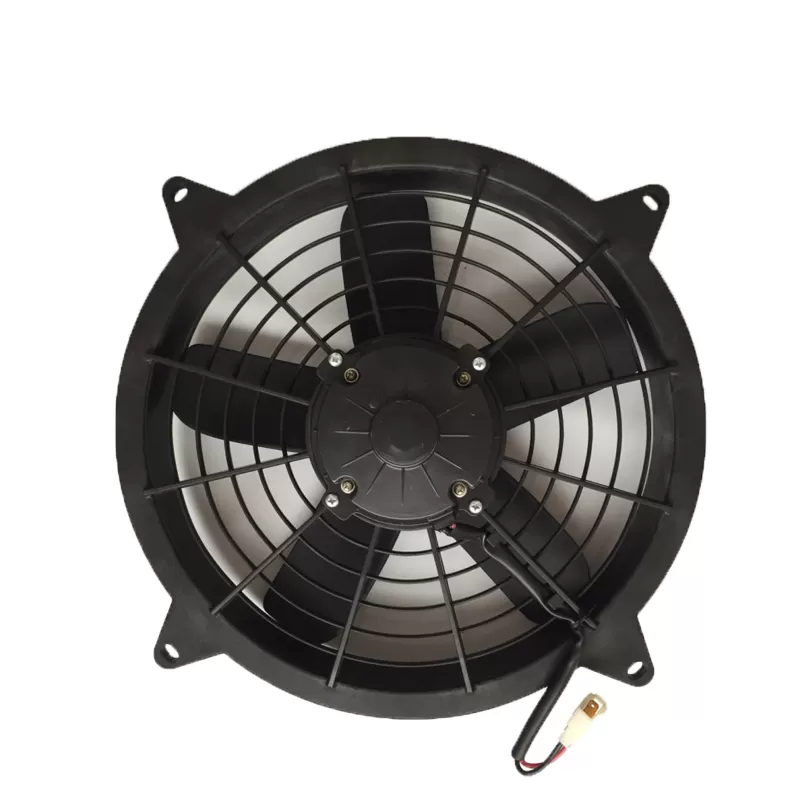
The condenser fan (high side) pulls or pushes ambient air through the condenser so the refrigerant can reject heat. It sets the thermal ceiling of the whole system. Weili's BLDC axial condenser fans, such as the 24V 340W unit rated around 2950 m³/h with IP68 sealing and a −20°C to +120°C range, or the LNF2781X axial rated at 1800 m³/h at 100 Pa, are built for exactly this high-resistance, high-heat duty. A weak condenser fan lets head pressure run high in traffic, and no cabin blower can fix a system that cannot shed heat.
The evaporator blower (cabin side) moves the conditioned air from the evaporator through the ducting to the driver. A healthy compressor and condenser mean nothing if this fan cannot deliver. The BLDC centrifugal blowers in the 100 to 160W class, such as the 24V unit rated at 600 m³/h at 100 Pa with a −40°C to +85°C range and PWM control, and the brushless ZHF2101ZW rated at 1000 m³/h at 100 Pa, cover steady cabin duty on long routes. For safety-linked defrost, a dedicated cabin fan such as the 180W CS2725 rated at 700 m³/h keeps the windscreen clear.
The sequencing rule follows from the physics. Upgrade the condenser fan first because it governs how much cooling the system can produce. Then upgrade the blower so that cooling actually reaches the cab. Upgrading both at once cuts repeat labour, but a staged approach lets you confirm the high-side gain before committing to the cabin side. Either way, treat the two as one project rather than two separate purchases.
From belt-driven to electronic, from brushed to brushless
Most airflow upgrades also modernise the drive. Replacing a mechanically driven, belt or clutch fan with an electronically controlled fan, and a brushed blower with a brushless (BLDC) one, is where the real headroom comes from. As the explainer on brushed versus brushless fans shows, brushless motors remove the wear point of a carbon brush and commutator, which matters under the vibration and heat a truck sees daily. Our guide to the role of condenser fans covers the high-side case in more depth.
The trade-off is control compatibility. A brushless or electronically controlled fan needs a compatible drive or built-in controller, and a PWM speed input the vehicle can supply. Do not assume a direct plug-in. Confirm the control interface, voltage, and mounting before ordering, or the new unit will spin on the bench and fail in the truck.
Specify the upgrade with your supplier
The number that sells a fan on a datasheet, free-air volume, is the number that misleads in a truck. What matters is airflow against the installed heat-exchanger static pressure, because the condenser or filter adds resistance the moment the fan is mounted. Hand your supplier the following so the recommendation is grounded in your vehicle, not a catalogue.
| Parameter | Why it decides the fit | What to give the supplier |
|---|---|---|
| Airflow at static pressure (m³/h at ___ Pa) | Free-air volume overstates real performance through the coil | The pressure your heat exchanger actually presents |
| Rotation and push or pull direction | Wrong direction bypasses the core or reverses flow | A drawing or blade marking of the current fan |
| Mounting (shroud, ring, bolt pattern) | The fan must physically seat in the existing package | Dimensions and a photo of the installed unit |
| Voltage and tolerance (typically 16 to 32V) | Survives idle dips and cranking spikes | Nominal system voltage and worst-case dip |
| Control interface (PWM specification) | Brushless and electronic fans need a matching drive | Controller details or built-in drive notes |
| Ingress rating (for example IP68) | Resists wash-down, dust, and moisture | The duty environment the truck runs in |
| Duty life and temperature range | Must match route heat and vibration | The route and duty profile |
Quality paperwork is a confirmation point, not a sales claim. Request the current certificate scope, issuing body, and the written warranty terms for the exact part number, and confirm the product listing covers your truck application before you specify. Weili product pages list applications across trucks, buses, heavy trucks, new-energy vehicles, and transport refrigeration; match the unit to your specific vehicle rather than assuming coverage.
FAQs
When should I upgrade airflow instead of repairing the compressor?
Upgrade airflow when the evaporator is cold but the cab is not, or when cooling fails at idle and in traffic while working at speed. If the compressor will not engage, there is no cold at the evaporator, or you have a confirmed leak, fix the refrigeration side first. The evaporator blower guide explains the cabin-side failure modes in detail.
Can I keep the belt-driven fan and only upgrade the cabin blower?
You can, and it is often the right first step if your symptom is weak cabin delivery rather than high-side heat rejection. But if the condenser fan is the bottleneck, a new blower will not help. Diagnose which side is weak first; the symptom table above separates the two. Confirm the condenser fan's airflow at static pressure before deciding it is fine.
Is swapping a brushed blower for a brushless one during the upgrade safe?
Only after confirming the control interface, voltage, mounting, and airflow point match. A brushless unit needs a compatible controller or built-in drive, and a direct plug-in is not guaranteed. Give the supplier the part number you are replacing so the recommendation covers the electrical and mechanical change alongside the airflow figure.
How do I prove airflow is the real bottleneck before spending?
Feel the evaporator: cold to the touch with a warm cab means air is not moving. Watch high-side pressure at idle and in traffic, and note whether cooling returns at highway speed. Check the blower amp draw, duct obstructions, and core cleanliness. Those checks separate an airflow limit from a compressor, clutch, or refrigerant fault.
What should I send the supplier to start a fitment review?
Your truck make and model, the current condenser fan and blower part numbers, the duty profile (idle time, climate, route), and the electrical details (nominal voltage, worst-case dip, control interface). With those, the supplier can check the airflow at static pressure, mounting, and application fit against the verified product range rather than guessing from free-air volume.